
Website Marketing: 10 Proven Strategies to Drive Traffic
Launching a site takes weeks. Getting the right people to find it, trust it, and buy from it takes a plan.
With more than 1.1 billion websites online, a site without a deliberate website marketing strategy is a shop with no road leading to it. Most businesses respond with scattered effort: a blog post here, a few paid ads there, an email list nobody emails. Each tactic might work on its own. None of them compound.
Business website marketing works when the pieces connect. A technically sound site earns rankings, useful content earns clicks, a clear conversion path turns clicks into leads, and analytics show which part to fix next. That sequence separates websites that generate revenue from websites that merely exist.
This guide shows how to market a website from the ground up, whether you are promoting a new website or growing an established one. You will learn what website marketing is, why it matters, what it delivers, and ten website marketing techniques with the specific actions and benchmarks behind each. SMB owners, marketing managers, and enterprise teams can use it as a working plan to increase business revenue with a website. For the wider picture, see our primer on what digital marketing is.
What is Website Marketing?
Website marketing is the practice of promoting a website to attract qualified visitors, engage them with useful content, and convert them into customers or leads. It combines search engine optimization, content marketing, conversion rate optimization, paid media, and email under one goal: moving a visitor along a defined path to a business outcome.
The terms web marketing and web site marketing get used loosely, but the distinction matters in practice. Using the web for marketing can mean anything from a social post to a podcast ad. Website marketing narrows the focus to the asset you own: your domain, your pages, your data. Every channel you run, from social to PR to paid search, exists to send people to that asset and persuade them to act once they arrive.
Core focus areas:
- Attraction: Earn qualified traffic through organic search, paid ads, social, and referrals. Quality beats volume. Five hundred visits from active buyers outperform five thousand from casual browsers.
- Engagement: Educate visitors with content that matches search intent at each stage, from "what is" questions to vendor comparisons.
- Conversion: Give users a short, obvious path to the business goal, whether that is a purchase, a demo request, or a phone call.
Gartner Digital Research: Gartner projects that roughly 80% of B2B sales interactions take place in digital channels, which makes the company website the main engine of commercial growth.
Put this to work: list every channel you run, then write down the one page each should send traffic to and the one action you want taken there. Channels without a destination page are where most marketing budgets leak.
Here is how the main disciplines divide the work:
|
Discipline |
Job in the funnel |
Core metric |
|
Earn organic visibility for buying-intent searches |
Non-brand organic sessions |
|
|
Educate and build topical authority |
Engaged sessions, assisted conversions |
|
|
Raise the share of visitors who act |
Conversion rate |
|
|
Buy immediate, targeted visibility |
Cost per acquisition |
|
|
Nurture visitors who are not ready to buy |
Revenue per email sent |
Why Website Marketing Is Important?
Your website is the one marketing channel you fully own, so it is the only place where brand messaging, pricing, and customer data stay under your control. Social platforms change reach overnight. Marketplaces change fees and rules. A well-marketed site depends on neither.
It is also usually the first touchpoint. Before a buyer calls, they search, skim two or three sites, and build a shortlist. A site nobody finds, or one that is found but fails to reassure, loses that buyer before the first conversation happens. For smaller firms, company website marketing is often the most affordable way to compete with larger rivals, because search results and landing pages reward relevance, not budget size.
Key growth drivers:
- Centralized digital touchpoints: PPC, social, PR, and email campaigns all point to one hub, so results are measured in one place.
- A 24/7 sales engine: Forms, chat, booking tools, and checkout capture demand outside business hours.
- Full funnel ownership: You control messaging, pricing, data, and user experience from first click to purchase instead of renting them from a platform.

Salesforce, State of the Connected Customer: 88% of customers say the experience a company provides is as important as its products or services.
What to do with that: audit the experience before buying more traffic. Load your five highest-traffic pages on a mid-range phone over mobile data. If any takes more than three seconds to show content or buries the main call to action, fix it first, because extra visitors only amplify the problem. Our guides on website user experience and how page speed affects SEO show where to start.
Benefits of Website Marketing
Website marketing compounds, while traditional advertising resets to zero the day you stop paying. A page that starts ranking in month six keeps delivering in month eighteen at almost no extra cost, and that long-term return is the core reason to invest in a structured plan.
Measurable advantages:
- Cost efficiency and high ROI: Organic search and content marketing build long-term traffic streams at a fraction of outbound advertising costs.
- Precise audience targeting: Reach prospects by search intent, demographics, and behavior instead of broad geography.
- Full data transparency: Granular analytics track visitor behavior, cost per acquisition (CPA), and campaign profitability in near real time.
- Scalable brand equity: Consistently publishing authoritative content builds industry credibility and domain strength that competitors cannot copy quickly.
DemandMetric: Inbound website marketing costs 62% less per lead than traditional outbound marketing while generating three times as many leads.
The contrast with outbound is easiest to see side by side. For a deeper look at the trade-offs, read our breakdown of inbound versus outbound leads.
|
Factor |
Website marketing |
Traditional outbound |
|
Cost behavior |
Upfront investment, falling cost per lead over time |
Cost rises in line with reach |
|
Targeting |
Search intent, behavior, demographics |
Broad audience or geography |
|
Measurement |
Session-level tracking through to revenue |
Estimated reach, limited attribution |
|
Longevity |
Rankings and content keep working |
Stops when spend stops |
|
Audience mindset |
Self-selected, already searching |
Interrupted, often not looking |
To check this against your own numbers, compare blended cost per lead from organic and referral traffic with paid and outbound channels over the last two quarters. Organic is usually cheapest and slowest, which is why the strongest plans run both.

10 Website Marketing Strategies To Grow Your Business
These marketing strategies for websites are ordered by dependency. If you are building a marketing strategy for a new website, work through them in sequence, because paid traffic and email only pay off once the site is fast, findable, and built to convert. If your site is already live, jump to strategy 10 first and use your analytics to find the weakest stage of the funnel.
1. Technical & On-Page SEO Optimization
Before driving traffic to your site, make sure search engines can crawl and index it and users can move through it without friction. Among website promotion methods, this is the one that makes every other method cheaper.
Action points:
Pass Core Web Vitals: aim for Largest Contentful Paint under 2.5 seconds, Interaction to Next Paint under 200 milliseconds, and Cumulative Layout Shift under 0.1. Our guide to Core Web Vitals covers the fixes.
- Test every template on mobile, not only the homepage.
- Map one primary long-tail query to each page, and place it in the title tag, H1, first paragraph, and URL.
- Add structured data such as Organization, Product, and FAQ using schema markup so search engines can read your content as entities.
- Run a quarterly crawl to catch broken links, redirect chains, and duplicate titles, or hand the audit to a technical SEO team.
BrightEdge Research: Organic search drives over 53% of all trackable website traffic, more than any other single channel.
2. Strategic Content Marketing & Pillar Pages
Authority comes from covering a subject more completely than your competitors do. Pick three to five core topics tied directly to revenue, then build each one as a cluster rather than a scattering of unrelated posts.
Action points:
- Publish one comprehensive pillar page per topic, then link 8 to 12 supporting articles to it and back.
- Match every page to a search intent: informational, commercial, or transactional.
- Use a content gap analysis to find questions competitors answer and you do not.
- Apply Google's E-E-A-T guidelines: named authors with credentials, first-hand examples, original data, and cited sources.
- Structure clusters around entities and related concepts, as explained in our overview of semantic SEO.
HubSpot: Businesses with active blogs generate 67% more leads per month than those without.
3. Conversion Rate Optimization (CRO)
Traffic you already have is the cheapest traffic to improve. A page converting at 2% that moves to 4% doubles lead volume without a single extra visitor.
Action points:
- Put one clear call to action above the fold, and repeat it after each major section.
- Cut form fields to the minimum you need to qualify a lead. Name, email, and one qualifying question outperform ten-field forms on most lead pages.
- Add trust signals near the action: client logos, certifications, short case studies, and review ratings.
- Test one variable at a time, and let each test reach statistical significance before declaring a winner.
- Follow the checklist in our guide to landing page optimization, and see how CRO and SEO work together.
VWO benchmarks: A/B testing and CRO programs commonly lift landing page conversion rates from an average near 2.35% to 11% or higher for top performers.
4. Pay-Per-Click (PPC) & Search Engine Advertising
SEO takes months. Search ads capture commercial demand this week. For advertising a website, start with the keywords that signal readiness to buy, such as "pricing," "services," "agency," and "near me," before touching broad awareness terms.
Action points:
- Launch Google Ads campaigns on high-intent commercial keywords using exact and phrase match first.
- Build a dedicated landing page for each ad group, with the headline repeating the promise made in the ad.
- Add negative keywords weekly from the search terms report to stop wasted spend.
- Set a target CPA before launch and pause ad groups that miss it after a statistically meaningful number of clicks.
- If in-house time is short, a specialist in Google Ads management can shorten the learning curve.
WordStream: Businesses average $2 in revenue for every $1 spent on Google Ads.
5. Retargeting & Paid Social Advertising
Most visitors leave without converting, and that is normal. Retargeting brings back the ones who showed interest, at a lower cost than reaching strangers.
Action points:
- Install the LinkedIn Insight Tag and Meta Pixel, and route them through a consent banner that meets GDPR and CCPA requirements.
- Build audiences by behavior: pricing-page visitors get a demo offer, blog readers get a related guide, and cart abandoners get a reminder.
- Exclude people who have already converted so you do not waste budget or irritate customers.
- Cap frequency at three to five impressions per person per week, and rotate creative every two to three weeks.
- Use LinkedIn for B2B decision-makers and Meta for consumer and local offers. Our guides on targeted advertising and social media marketing services explain how to match platforms to audiences.
Invesp: Website visitors retargeted with display ads are 70% more likely to convert.
6. Automated Email Marketing & Lead Nurturing
A visitor who is not ready to buy today still has a future need. Email keeps your brand present while that need develops.
Action points:
- Offer a lead magnet worth trading an address for, such as a benchmark report, a template, or a free site audit.
- Send a welcome sequence of three to five emails over about ten days: deliver the asset, share a proof point, answer the top objection, then make one clear offer.
- Segment by source and behavior so a pricing-page visitor never receives the same message as a first-time blog reader. See our guide to email segmentation.
- Trigger follow-ups from site behavior using marketing automation, and track revenue per send, not only open rate.
- Read more on turning subscribers into pipeline in email marketing lead generation.
Litmus: Email marketing returns an average of $36 for every $1 spent.
7. Local SEO & Google Business Profile Optimization
If you serve customers in a defined area, local visibility often matters more than national rankings. Searches with local intent convert well because the buyer is ready to act.
Action points:
- Keep Name, Address, and Phone (NAP) identical across your site, Google Business Profile, and directories. Inconsistent listings dilute trust signals, as covered in our guide to local SEO citations.
- Complete every Google Business Profile field: primary and secondary categories, services, hours, photos, and a weekly post.
- Add LocalBusiness schema and a dedicated page for each location or service area.
- Ask every satisfied customer for a review within 48 hours of the job, and reply to every review, positive or negative.
- Review the local SEO ranking factors that move map-pack positions, or bring in a local SEO specialist.
Think with Google: 76% of people who search on a smartphone for something nearby visit a business within a day.
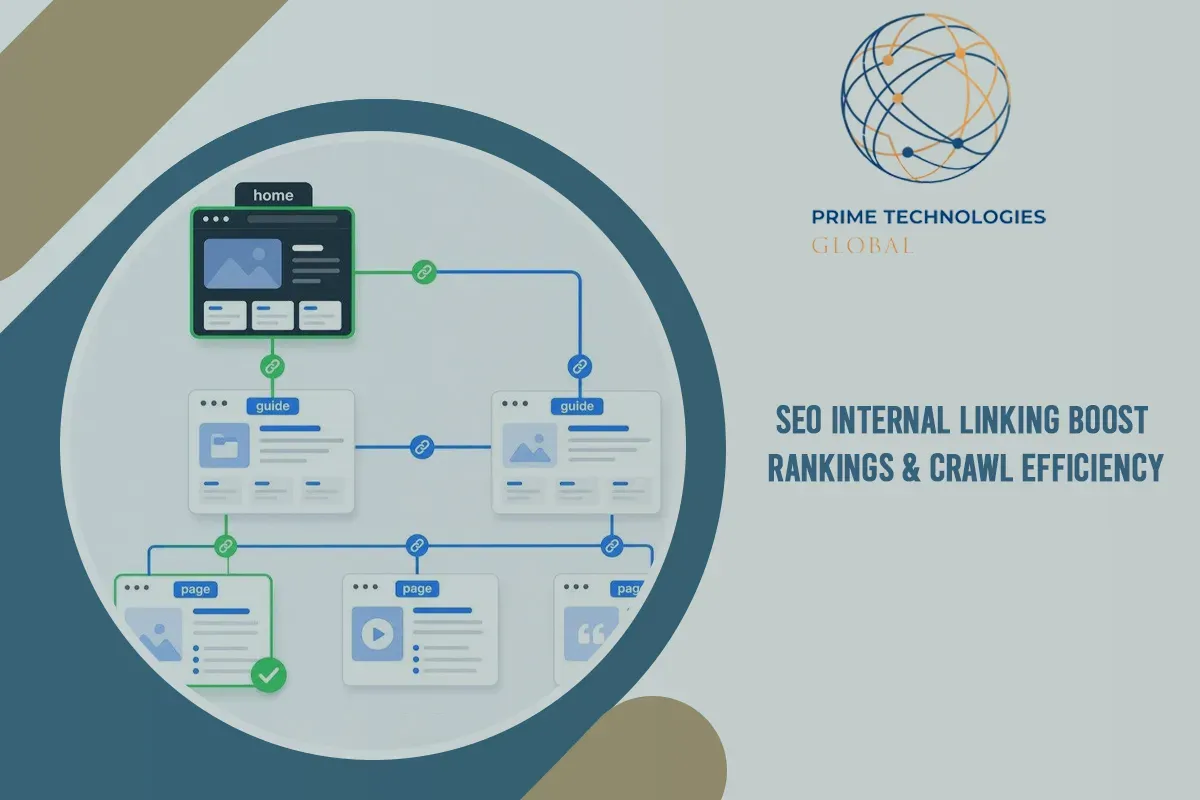
8. Strategic Internal Linking & Site Architecture
Internal links decide which pages search engines treat as important and how easily visitors reach your money pages. It is the cheapest ranking lever you control, and most sites neglect it.
Action points:
- Keep every important page within three clicks of the homepage.
- Link related articles contextually, using descriptive anchor text such as "local SEO checklist" instead of "click here."
- Point supporting posts at the service or product page they should help rank.
- Find orphan pages with no internal links, and either link to them or remove them.
- Fix broken links monthly. A free crawler such as Screaming Frog handles up to 500 URLs.
- Our guides on SEO internal linking and the traits of an SEO-friendly website give a full audit process.
Ahrefs studies: Contextually relevant internal links significantly improve crawl frequency and page-level ranking power.
9. Social Proof, Case Studies & User Reviews
Buyers discount what you say about yourself and weigh what others say about you. Proof placed next to a call to action removes the last bit of doubt.
Action points:
- Record short video testimonials from customers, and place them on service and pricing pages.
- Write case studies with a measurable before-and-after, such as "organic leads up 140% in six months," not vague praise.
- Embed live review widgets from Google, G2, or Trustpilot on sales pages, where visitors weigh the decision.
- Publish a dedicated page of client testimonials and link to it from conversion pages.
- Treat reviews as part of search visibility too. See how SEO reputation management protects brand queries.
Sprout Social: 89% of consumers read reviews before making a buying decision online.
10. Analytics, Behavioral Tracking & GA4 Integration
Every decision above should trace back to a number. Without measurement, you cannot tell which of ten tactics earns its budget.
Action points:
- Configure GA4 key events for the actions that matter: form submissions, calls, purchases, and demo bookings.
- Connect Google Search Console to see which queries bring impressions but few clicks, then rewrite those titles and descriptions.
- Watch session recordings and heatmaps in Hotjar or Microsoft Clarity to see where visitors stall.
- Audit content monthly. Refresh pages whose traffic dropped, and merge or remove pages that no longer earn visits.
- Start with clear marketing objectives, then apply conversion funnel optimization to the stage where most visitors drop out.
Track this core set on a fixed schedule:
|
Metric |
What it tells you |
Review cadence |
|
Non-brand organic sessions |
Whether SEO is reaching new audiences |
Monthly |
|
Conversion rate by landing page |
Which pages persuade and which leak |
Weekly |
|
Cost per acquisition by channel |
Where paid budget earns its keep |
Weekly |
|
Engaged session rate |
Whether content matches intent |
Monthly |
|
Revenue per email sent |
Whether nurture sequences pay off |
Monthly |
McKinsey & Company: Data-driven organizations are 23 times more likely to acquire customers and six times as likely to retain them.

Conclusion
Website marketing works when each stage feeds the next. A fast, crawlable site earns the rankings that content then captures. Conversion work turns that traffic into leads. Paid media, retargeting, and email extend reach and recover the visitors who left, and analytics keep the whole system honest. Skip a stage and the others underperform, which is why sequence matters more than any single tactic.
A practical first quarter looks like this. Spend the first month on the foundation: fix Core Web Vitals, clean up titles and internal links, and set up GA4 key events. Use the second month to publish one pillar page with its supporting cluster and rebuild your three highest-traffic landing pages for conversion. In the third month, launch search ads on your highest-intent keywords, switch on retargeting, and start a welcome email sequence. By day 90 you will have a measurable baseline for every channel and a clear view of where the next dollar belongs. For a lighter planning template, see our quick digital marketing plan.

Scale Your Digital Growth with Prime Technologies Global
Building a high-performing online website marketing strategy is complex, and you do not have to carry it alone. Prime Technologies Global provides end-to-end digital marketing, search engine optimization, and enterprise web engineering built to increase visibility and drive measurable revenue.
Whether you need a ground-up website marketing strategy, a technical performance audit through our technical SEO services, or high-converting content architecture from our content marketing team, our specialists start from where your site stands today. Explore our services or contact the team to book a consultation and put this plan to work.
FAQ’s
What is meant by web marketing?
Web marketing refers to the process of promoting a brand, product, or service over the internet using digital tools like search engines, social media, and email. Its primary goal is to drive online traffic, engage targeted audiences, and convert visitors into paying customers.
Can you give me an example of web marketing?
An e-commerce shoe brand using Google Search Ads to show up at the top of results when someone searches "best running shoes" is a classic example. When the user clicks the ad, reads an optimized product page, and makes a purchase, the entire web marketing engine achieves its goal.
What does a web marketer do?
A web marketer plans, executes, and analyzes online promotional strategies across channels like SEO, paid advertising, content, and email. They continually measure user behavior and campaign analytics to drive website traffic, generate qualified leads, and boost sales.
Does digital marketing really make you money?
Yes, digital marketing generates direct revenue by connecting your business to ready-to-buy customers at scale. When executed with targeted strategies and measurable conversion tracking, it consistently delivers a high return on investment (ROI).