
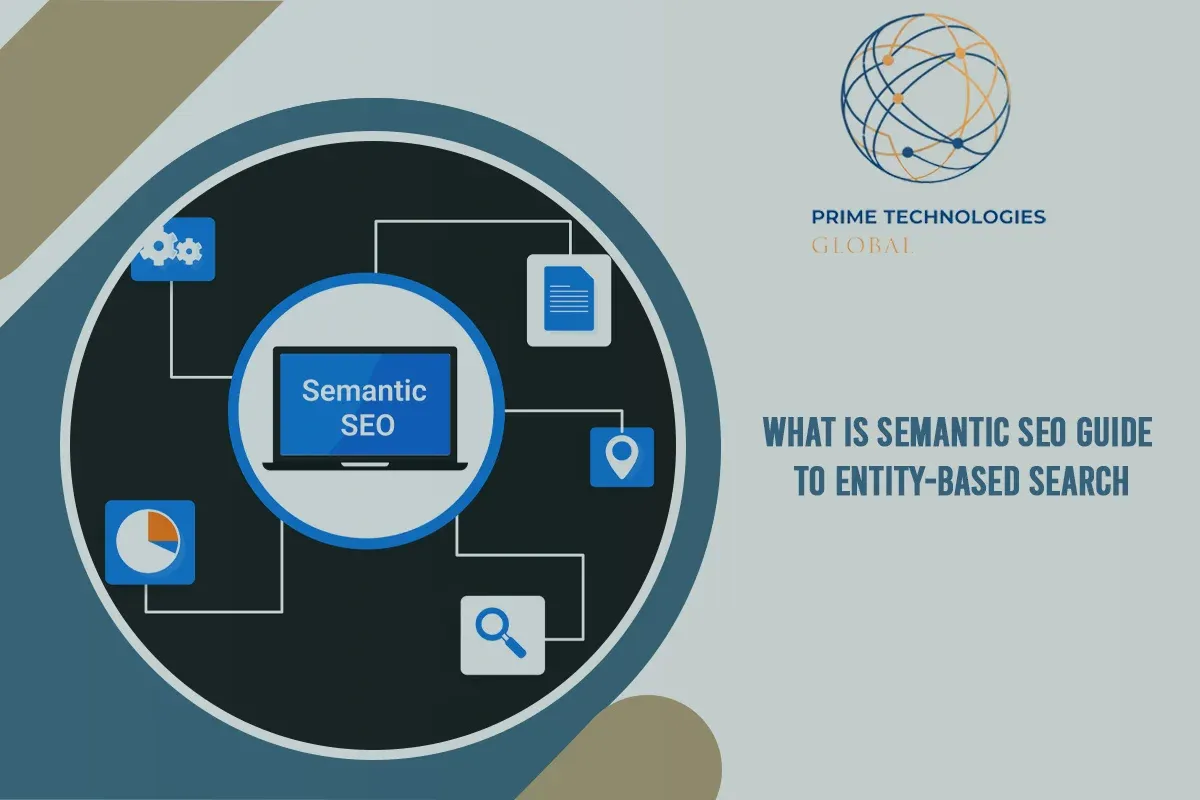
What Is Semantic SEO? | Guide to Entity-Based Search
For over a decade, SEO ran on a simple formula: find a high-volume keyword, drop it into the title tag, and repeat it often enough to satisfy a density target. That formula is dead. Modern search engines no longer match strings of text; they interpret meaning, context, and intent, which is exactly what semantic SEO is built to address.
Google's ranking systems now lean on advanced language models and the Knowledge Graph to judge content holistically. Pages built around isolated keywords miss the thousands of related, conversational queries and they rarely get pulled into AI Overviews or other generative summaries. Understanding semantic search SEO, and what is semantic SEO at a practical level, is no longer optional for anyone competing on organic visibility.
This guide breaks down semantic SEO meaning, the algorithms behind it, and a step-by-step semantic SEO strategy you can apply today from semantic keyword research and topic clusters to seo semantic markup and generative engine optimization (GEO).
- The core mechanics of semantic search: entities, intent, and the algorithms behind them.
- A repeatable process for semantic keyword research and topic cluster planning.
- How to apply semantic markup SEO, structured data, and internal linking correctly.
- How to future-proof content for AI-driven search engines like AI Overviews, ChatGPT Search, and Gemini.
Understanding Semantic SEO: Moving From Words to Concepts
Semantic SEO is the practice of building content around topical meaning, entities, and context rather than exact-match keyword repetition. Instead of asking “where do I place this keyword,” semantic SEO asks “what concepts, relationships, and questions define this topic completely?” That shift is the semantic SEO meaning most practitioners now work from.
Traditional SEO vs Semantic SEO
The clearest way to see the shift is side by side. Traditional SEO treated each page as an isolated bet on a single query string. Semantic SEO treats a domain as a network of interconnected concepts that collectively prove expertise on a subject.
|
Traditional Keyword SEO |
Modern Semantic SEO |
|
Exact-match keywords and keyword density |
Entity relationship mapping and full topical coverage |
|
Single-page isolation |
Interconnected topic clusters and spoke content |
|
Written to match one query string |
Written to resolve underlying user intent comprehensively |
|
Ranks on keyword frequency signals |
Ranks on entity salience and topical depth signals |

The Evolution of Search Engine Algorithms
Google's move toward semantics in SEO didn't happen overnight. A handful of core updates mark the timeline that today's practitioners still reference:
- Hummingbird (2013): introduced conversational search and parsed queries by context rather than by string.
- RankBrain (2015) and BERT (2019): gave the algorithm the ability to understand sentence-level nuance and word relationships.
- MUM and Gemini integration: multimodal models that understand context across formats and languages, powering today's AI Overviews.

The Building Blocks of Semantic Search: Entities, Salience, and Intent
An entity is a single, well-defined concept, person, place, or thing that search engines can identify and disambiguate the way a knowledge graph tells “Apple” the fruit apart from “Apple” the technology company. Entities, not keywords, are the atomic unit that semantic search SEO is built around.
What Are Entities and Why Are They Replacing Keywords?
Keywords describe how a person types a query. Entities describe what that query is actually about. A page optimized only for a keyword string can still miss the entity relationships that prove real topical depth which is why semantic analysis SEO increasingly looks at co-occurring terms instead of raw keyword counts.
Entity salience measures how central a given entity is to a piece of content, and co-occurrence measures how often related entities appear alongside it. Content that naturally mentions the full cluster of concepts a topic requires signals depth; content that repeats one phrase in isolation signals thinness.
Unlocking Search Intent (Informational, Navigational, Transactional, Commercial)
Satisfying intent means answering the stated question and the next two or three questions a reader will naturally have. A page about “semantic SEO strategy” that stops at a definition, without addressing implementation or tools, leaves intent half-satisfied and search engines are increasingly able to detect that gap.
Essential semantic components every well-optimized page should include:
- Primary entity: the core concept the page is built around.
- Secondary and related entities: supporting concepts, sub-topics, and definitions that prove depth.
- Contextual anchor text: descriptive link text that defines the relationship between two pages, rather than generic phrases.
How to Execute a Semantic Keyword & Entity Research Strategy
Semantic keyword research starts with a pillar topic and expands outward into the full set of entities, questions, and related searches that define it rather than starting and ending with a single search-volume number.
Mapping Topics with Knowledge Graphs & SERP Features
Start by identifying the core pillar topic, then map every subtopic, related query, and People Also Ask (PAA) question attached to it. From there, extract the co-occurring terms that appear across the top-ranking pages for that query; this is where semantic keywords and semantic keyword variants naturally surface.
Leveraging Semantic Research Tools
Purpose-built platforms make this process far faster than manual SERP review. Clearscope, Surfer SEO, MarketMuse, and SEMrush's Topic Research tool all score content against the semantic terms in SEO that top-ranking competitors already use, flagging gaps before you publish.
Technical teams sometimes go a layer deeper and build their own scoring pipeline a semantic SEO python script using an NLP library such as spaCy or Google's Natural Language API can extract entities and salience scores directly from competitor URLs, which is useful when off-the-shelf tools don't cover a niche vertical closely enough.
A repeatable process for finding entity gaps:
- SERP scraping: analyze the top five ranking pages for recurring concepts, FAQs, and definitions.
- Knowledge Panel analysis: review which entities Google already associates directly with the broader niche.
- AI Overview and PAA mining: collect the questions search engines already synthesize at the top of the results page.
Structuring Content Architecture with Topic Clusters & Internal Links
A pillar-and-spoke model organizes one comprehensive authority page (the pillar) alongside eight to fifteen supporting subtopic pages (the spokes), all linked bidirectionally and it remains the most reliable content architecture for building topical authority at scale.
The Pillar-and-Spoke Model for High Topical Authority
The pillar page covers a broad topic at a summary level and links out to each spoke for depth; each spoke links back to the pillar and sideways to closely related spokes. That structure mirrors how a knowledge graph itself organizes entities: a central node connected to a web of related, specific nodes.
Optimizing Contextual Internal Anchor Text
Generic anchor text like “click here” or “read more” carries no entity information and wastes a ranking signal. Descriptive, entity-rich anchor text such as “learn how schema.org structured data works” tells crawlers exactly what relationship exists between the two pages.

On-Page Tactics: Schema Markup, Natural Language, and FAQs
Seo semantic markup implemented through Schema.org JSON-LD explicitly tells search engines which entities a page is about, rather than leaving that inference to the crawler alone. It is one of the highest-leverage, lowest-effort tactics available in semantic markup SEO.
Implementing Schema Markup (Structured Data)
The schema types most relevant to semantic SEO are Article, FAQPage, Organization, ItemPage, and AboutPage. Each one declares specific entities and their attributes directly in code, removing ambiguity for crawlers evaluating the page.
Semantic URLs matter here too. A URL such as /semantic-seo-guide describes the entity the page covers in plain language; a URL built from an internal ID or a string of parameters gives crawlers and users no contextual information at all. Clean, descriptive semantic urls are a small but real part of the overall semantic web SEO picture, since Google's approach to google semantic web signals traces back to the same structured, linked-data principles the W3C originally proposed for the semantic web.

Writing for Natural Language Processing (NLP) Algorithms
Clear subject-predicate-object sentence structure parses more reliably than long, clause-heavy sentences. Headers phrased as direct questions, paired with a concise answer immediately underneath, are what most reliably qualifies for a Featured Snippet or voice search result.
Generative Engine Optimization (GEO) & AI-First Search
Generative Engine Optimization, sometimes referred to as cognitive SEO, is the practice of structuring content so large language models can accurately extract, summarize, and cite it inside AI-generated answers which makes it the natural extension of semantic search optimization rather than a separate discipline.
Optimizing for Google AI Overviews, ChatGPT Search, and Gemini
The same entity clarity that helps traditional rankings helps generative engines even more, since these systems synthesize an answer from several sources rather than sending a click to just one. E-E-A-T signals original research, named expert authorship, and verifiable credentials are what these systems weigh most heavily when deciding which entity to trust and cite. The importance of semantic keywords in SEO is only growing as more queries resolve inside an AI answer box rather than a traditional ten-blue-links page.
A short checklist for AI visibility:
- Direct, concise definitions placed near the top of the page.
- Well-structured tables and lists that are easy for a model to extract cleanly.
- Explicit citations of primary research and named authoritative sources.
Bringing It All Together
Semantic SEO moves the discipline beyond rigid keyword matching toward a model built on entities, genuine search intent, and comprehensive topical coverage, and that shift explains why so many keyword-dense pages have quietly lost rankings over the past few years. Building structured topic clusters, applying seo semantic markup correctly, and linking pages with descriptive, entity-rich anchor text are what now separate domains that dominate a subject from domains that merely mention it. As AI Overviews and conversational search interfaces take a larger share of every results page, a semantic SEO mindset isn't just a ranking tactic it's the difference between being cited by these systems and being invisible to them.
None of this has to be figured out from scratch. Prime Technologies Global builds semantic content architecture, structured data, and topic clusters as a core part of its SEO and digital marketing services, and our team can turn the strategy in this guide into an implementation plan for your site. If you're ready to restructure your content into a fully connected topic cluster, close entity gaps competitors have missed, or get your pages showing up inside AI-generated answers, reach out to Prime Technologies Global today to talk through what that would look like for your business.
FAQ’s
What is a semantic SEO example?
A common example is writing one comprehensive page on “home coffee brewing methods” that naturally covers related entities pour-over, French press, espresso, grind size, water temperature instead of publishing five thin pages each repeating a single exact-match keyword.
What is semantic search SEO?
Semantic search SEO is the practice of optimizing content so search engines understand it by meaning and entity relationships rather than by matching literal keyword strings, which improves relevance for the full range of related queries a topic can generate.
What are the 4 types of SEO?
The four commonly referenced types are on-page SEO, off-page SEO, technical SEO, and local SEO. Semantic SEO is not a separate fifth category it is a modern layer that runs through on-page and technical SEO, shaping how content and markup are structured.
What is the difference between SEO and semantic SEO?
SEO is the broad discipline of improving organic visibility through technical health, content, and links. Semantic SEO is a specific approach within that discipline, focused on entities, topical depth, and context rather than on keyword frequency alone.