
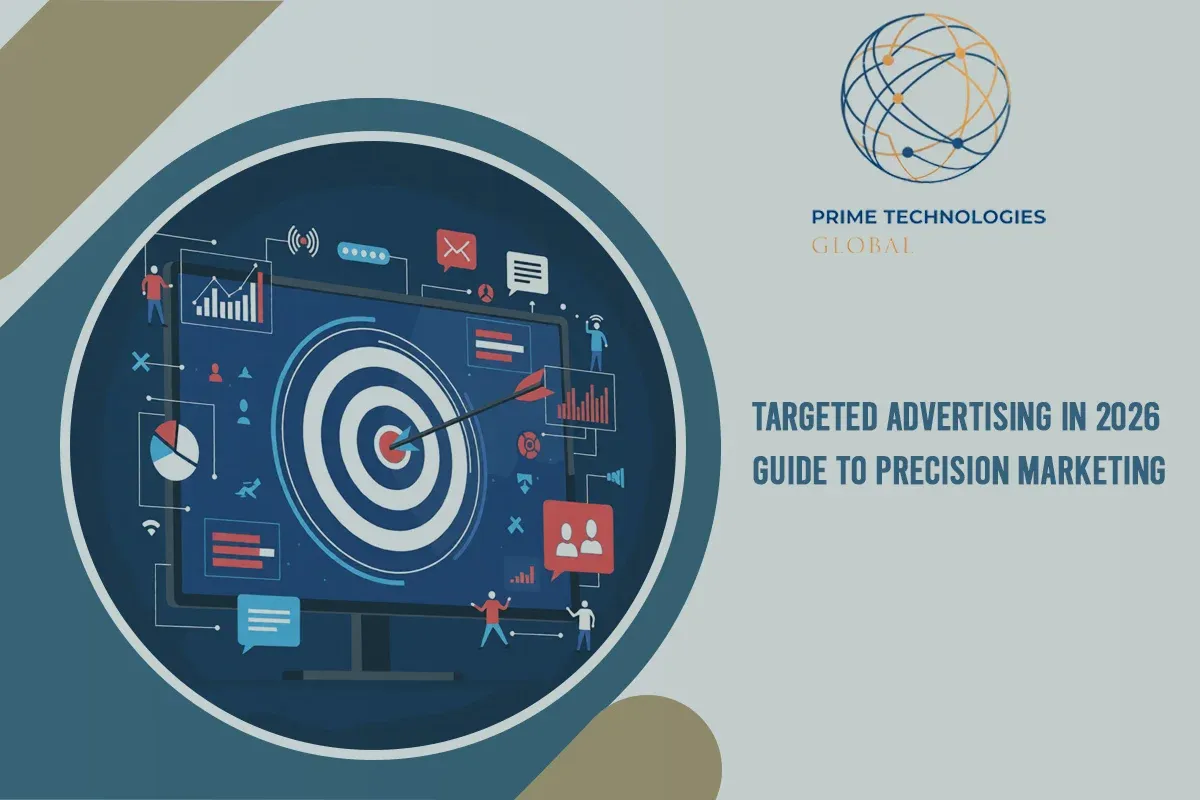
Targeted Advertising in 2026: Guide to Precision Marketing
Generic marketing is a fast track to wasted spend. Targeted advertising has become the default operating model for brands that want to reach the right buyer without burning budget on the wrong one and consumers now expect it rather than merely tolerating it. The strategic question is no longer whether to run targeted ads, but how to run them well while third-party cookies disappear and privacy law tightens around every click.
This guide breaks down how targeted advertising works, the core strategies driving revenue today, and the modern targeted advertising services and tools marketers need to reach the right audience without crossing a privacy line. Along the way, it covers real audience-targeting mechanics, the business case for targeted digital marketing, and a practical setup checklist you can act on this quarter.
What Is Targeted Advertising? Defining the Fundamentals
The targeted advertising definition most marketers work from is straightforward: serving ads to specific audiences based on demographics, behavior, interests, or location, rather than broadcasting one message to everyone. To define targeted advertising in practice, think of it as matching a message to a person who has already signaled interest in it through what they searched, where they browsed, or who they resemble statistically.
That is a fundamentally different model from traditional "spray and pray" broadcasting. A billboard or a prime-time TV spot reaches everyone driving past or watching the channel, regardless of whether they are in-market for the product. Target advertising flips that logic: the ad network reads data signals, search history, app behavior, purchase patterns, device and location data and matches a user profile to the advertiser whose offer is statistically most relevant to that profile, in real time, at auction.
|
Fast Fact Global digital ad spending is on pace to hit $1.17 trillion in 2026, according to eMarketer's H1 2026 worldwide ad-spending report with digital channels continuing to take share from traditional media even as overall ad budgets grow. (Verify current figures before publishing.) |

Core Types of Audience Targeting Strategies
"Targeted advertising" is really an umbrella term for several distinct execution methods. Marketers researching targeted advertising examples and targeted ads examples usually find that most real campaigns blend two or three of the categories below rather than relying on just one.
|
Strategy |
How It Works |
Best Use Case |
|
Behavioral targeting |
Tracks web history, search queries, and purchase data to infer intent e.g., retargeting a shopper who abandoned a cart. |
Retargeting, mid-funnel nudges |
|
Contextual targeting |
Places ads on pages directly relevant to the product, independent of user tracking e.g., a running-shoe ad on a marathon-training blog. |
Cookie-restricted environments, brand safety |
|
Demographic & geographic targeting |
Filters by age, gender, income, and physical location, including hyper-local radius targeting. |
Local services, regional launches |
|
Lookalike / actalike audiences |
Uses seed data from current best customers to find statistically similar users across an ad network. |
Scaling proven customer segments |
Contextual targeting deserves particular attention in 2026. It has moved from a fallback tactic to a primary strategy precisely because it does not depend on cross-site tracking, a critical advantage as social media ad targeting and open-web retargeting both face mounting restrictions.

Why Targeted Ads Matter: The Business Benefits
The business case for targeted marketing rests on three measurable outcomes: higher conversion, lower waste, and a better experience for the person seeing the ad.
- Higher conversion rates: Reaching people already in the consideration or intent phase of the funnel, rather than cold audiences with no prior signal.
- Cost efficiency and reduced ad waste: Lower cost-per-click and a stronger return on ad spend, since budget is not spent showing ads to people who were never going to buy.
- Enhanced user experience: Ads that function as solutions to a need the person already has, rather than interruptions to whatever they were doing.
McKinsey's research on personalization, the discipline underpinning most modern targeted advertisement strategy, found that personalized marketing can cut customer acquisition costs by as much as 50%, lift revenue by 5% to 15%, and improve marketing ROI by 10% to 30%. Companies that grow faster than their peers also derive roughly 40% more of their revenue from personalization efforts, a gap that compounds year over year.
Navigating the Privacy Paradigm: Cookies, Consent, and Compliance
The biggest operational shift in targeted digital advertising right now is the erosion of third-party tracking. Apple's App Tracking Transparency (ATT) framework requires an explicit opt-in before an app can track a user across other companies' apps and sites, and Google's Privacy Sandbox is phasing out third-party cookies in Chrome along similar lines.
Multiple industry benchmarks through 2026 place ATT opt-in rates at roughly 15% to 30% globally meaning the large majority of iOS users decline cross-app tracking when asked directly. That single consent screen has quietly removed most of the signal that targeted online advertising relied on for attribution and retargeting a few years ago.
The practical response has been a shift toward data brands own outright:
- First-party data: Information collected directly from your website, app, or CRM purchase history, on-site behavior, email engagement.
- Zero-party data: Information a user intentionally shares, such as through a preference center, quiz, or loyalty program sign-up.
Both categories sidestep the consent gap entirely, since the person has already agreed to share the data with you specifically. Compliance still has to hold underneath all of its GDPR in the EU, the CCPA/CPRA in California, and a growing patchwork of comparable state and national laws mean consent management and data-retention policy are no longer optional line items.

Step-by-Step: Setting Up a Successful Targeted Ad Campaign
Turning the strategy above into a running campaign follows a repeatable sequence, regardless of which platform you launch on.
- Define your Ideal Customer Profile (ICP): Narrow down the data personas you are actually building creative and offers around don't target everyone who could plausibly buy.
- Select the right platforms: Match audience to channel LinkedIn for B2B technology buyers, Meta or TikTok for consumer products, search for high-intent transactional queries.
- Implement robust tracking: Set up conversion APIs and server-side tracking so measurement survives browser-level blocks rather than depending on client-side pixels alone.
- A/B test creative and copy: Continually test visual assets and messaging against different audience segments instead of freezing a single winning ad indefinitely.

Conclusion
Targeted advertising remains the fastest route to efficient growth, but the mechanics behind it have changed for good. Success no longer depends on quiet background tracking across the open web; it depends on transparent, first-party data structures, contextual placement, and measurement that survives a consent decline. Brands that build that foundation now will keep compounding gains as the rest of the privacy landscape continues to shift; brands that don't will keep losing signal every time a platform tightens its rules.
Maximize Your Digital Growth with Prime Technologies Global
Navigating the compliance requirements, algorithmic ad platforms, and ROI pressure behind modern targeted advertising takes a dedicated partner, not another dashboard. Prime Technologies Global builds first-party data infrastructure, contextual and audience-targeting strategy, and measurement frameworks that hold up as the privacy landscape keeps shifting so your ad spend keeps converting instead of quietly losing signal.
Ready to turn targeting strategy into predictable pipeline? Partner with Prime Technologies Global to build a future-proof, privacy-first advertising engine.
FAQ’s
What is an example of targeted advertising?
A common example is retargeting: someone browses running shoes on an online store, leaves without buying, and later sees an ad for that exact pair of shoes on a different website or social feed. Another example is contextual targeting a project-management software ad appearing on a productivity blog because the content itself signals relevant intent.
Does targeted advertising actually work?
Industry research on personalization, the discipline behind most targeting strategies, points to measurable gains in conversion rate and cost efficiency, though results vary widely by execution quality and data hygiene. Poorly targeted campaigns built on stale or low-quality audience data underperform broad campaigns; well-targeted campaigns built on clean first-party data consistently outperform them.
How do I opt out of targeted advertising?
On iOS, declining the App Tracking Transparency prompt (or disabling "Allow Apps to Request to Track" in Settings) opts a user out of cross-app tracking. On the open web, browser-level cookie controls, the Global Privacy Control signal, and individual ad-platform preference centers (Google Ads Settings, Meta Ad Preferences) let users limit or disable personalized ads.
What is targeting in advertising?
Targeting in advertising is the practice of defining which audience segment should see a given ad by behavior, demographic, location, interest, or similarity to existing customers instead of showing the same ad to every viewer regardless of relevance.