

How Important Is Page Speed for SEO? | Key SEO Impact
Does page speed affect SEO enough to change where a page lands on page one? For sites that already compete on strong content and backlinks, the answer is yes and it's often the only lever left to pull. How important is page speed for SEO becomes obvious the moment two competing pages match on relevance and authority: the faster page typically wins the tie. This guide breaks down page speed and SEO from every angle that matters Google's official position, the Core Web Vitals metrics used to grade performance, the indirect ranking damage caused by high bounce rates and wasted crawl budget, and the revenue lost to slow page loading speed. It closes with a step-by-step page speed optimization framework that technical SEOs and site owners can put to work today.
Is Page Speed a Ranking Factor? Google's Official Position
Google has weighed site speed into search rankings since the 2010 "Speed Update" for desktop, expanded it to mobile in 2018, and formalized it further with the Page Experience update and Core Web Vitals rollout in 2021. Google Search Central's own documentation on page experience signals confirms that performance is one of many factors search algorithms account for, but it has never been positioned as the dominant one.
In practice, page speed functions as a tie-breaker signal. When two pages are roughly equal in relevance, depth, and authority, the faster-loading, more stable page has an edge. A page with mediocre content will not outrank a comprehensive, well-linked competitor purely by loading fast but among pages that already satisfy search intent, pagespeed can be the deciding factor for who takes the top slot.

|
KEY TAKEAWAY Page speed rarely wins a ranking on its own. It acts as a tie-breaker among pages that already satisfy search intent which is exactly why it matters most for sites already investing in strong content and link-building. |
Lab Data vs. Field Data: Why CrUX Wins
A common misconception is that Google ranks pages using Lighthouse lab scores. It does not. Google's ranking systems draw on the Chrome User Experience Report (CrUX) real-world, field-collected performance data gathered from actual Chrome users who visited a page. Lighthouse and PageSpeed Insights lab scores remain useful diagnostic tools for finding and fixing problems, but the ranking-relevant number is what real visitors on real devices and real networks experienced, aggregated over a rolling 28-day period.
Core Web Vitals: The Metrics That Actually Rule Search Rankings
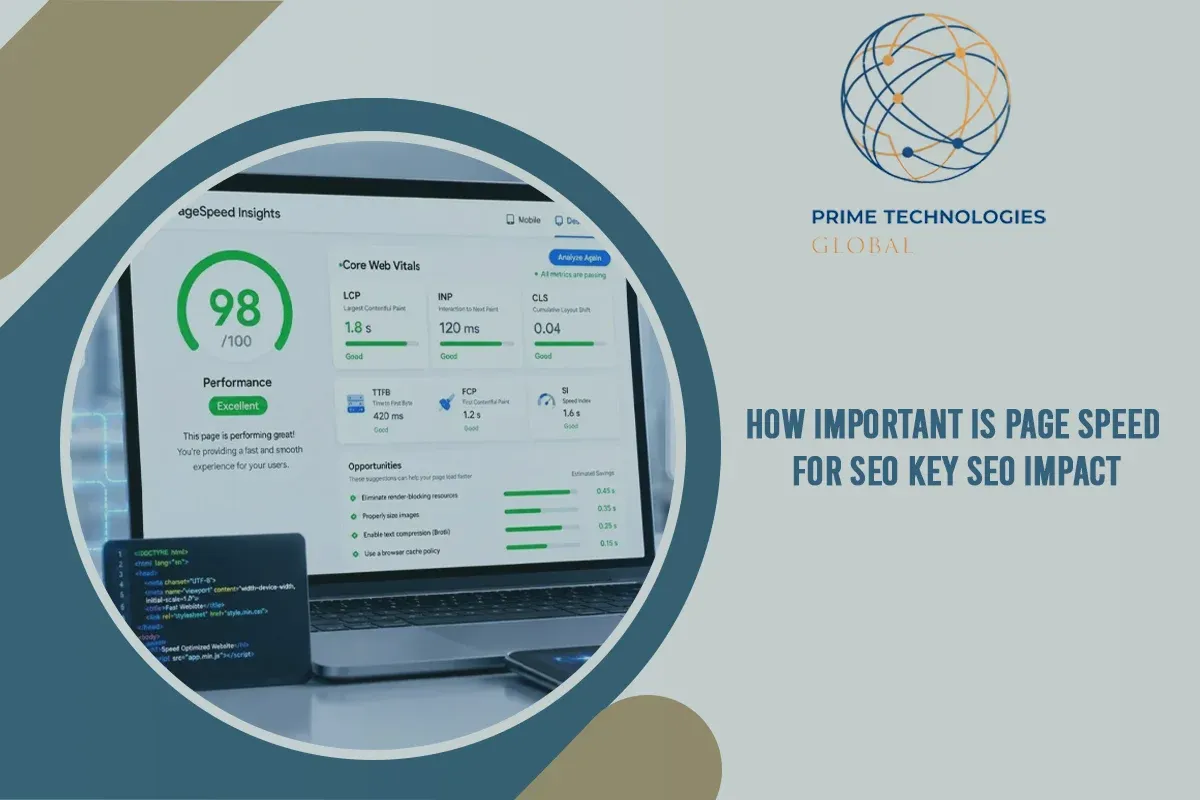
Core Web Vitals are the specific, quantifiable standards Google uses to grade page performance and page speed ranking factor status. Three metrics make up the current set, each targeting a different dimension of user experience:
Largest Contentful Paint (LCP)
LCP measures loading performance specifically, how long it takes for the largest visible content element (a hero image, a headline block, a video poster) to render. Google's benchmark for "good" is 2.5 seconds or less, measured from when the page starts loading.
Interaction to Next Paint (INP)
INP measures responsiveness, the delay between a user's click, tap, or keypress and the moment the browser visually responds. It replaced First Input Delay (FID) as an official Core Web Vital in March 2024 because it captures responsiveness across the entire page visit, not just the first interaction. The target threshold is 200 milliseconds or less.
Cumulative Layout Shift (CLS)
CLS measures visual stability how much visible content unexpectedly shifts position while a page is loading (the classic case: a user goes to tap a button and an ad loads above it, shifting the layout and causing a mis-click).
Pagespeed optimization work should treat these three thresholds as the practical definition of "fast enough" not an arbitrary lab score, but the field-measured experience Google is actually grading.

The Indirect SEO Impact: Bounce Rate, Crawl Budget, and Mobile-First Indexing
Bounce Rate and Dwell Time
Slow pages don't just risk a direct ranking penalty; they poison the engagement signals search algorithms use as a proxy for quality. A visitor who bounces off a slow-loading page within seconds never generates the dwell time, scroll depth, or return-visit behavior that signals "this page satisfied the query." Over enough sessions, that pattern becomes a drag on rankings even without Google ever scoring speed directly.
Crawl Budget Optimization
For large sites, slow Time to First Byte (TTFB) and heavy server response times throttle how many pages Googlebot can crawl in a given window. A site with a bloated crawl budget wasted on slow responses gets fewer new or updated pages discovered and indexed promptly which is a direct SEO cost for publishers and e-commerce catalogs that update frequently.
Mobile-First Indexing Constraints
Because Google indexes primarily from the mobile version of a page, and mobile networks routinely carry higher latency and more variable bandwidth than desktop connections, page loading speed problems are amplified on mobile. A site that loads acceptably on a fiber desktop connection can still fail Core Web Vitals badly on the mobile data connections most real users are on and mobile-first indexing means that's the version Google judges.
The Business ROI of Page Speed: Conversions and Revenue
Site speed for SEO is ultimately a business metric, not just a developer checklist item. The relationship between load time and conversion rate has been documented across both B2B and B2C sectors:
|
Metric / Sector |
1-Second Load Time |
5-Second Load Time |
Impact of 1s Delay |
|
B2B Conversions |
Baseline (high) |
~3x lower conversion rate |
Up to 20% drop in mobile conversions |
|
E-Commerce (B2C) |
Baseline (high) |
~2.5x lower conversion rate |
~8.4% drop in overall sales conversions |
The strategic implication is straightforward: site performance is a growth lever that sits at the intersection of engineering, SEO speed, and revenue operations. Treating it as a one-time developer task rather than an ongoing budget line is the most common reason gains erode within a year.

Step-by-Step Guide to Page Speed Optimization
Improving page speed for SEO is a layered exercise infrastructure, assets, and rendering path each contribute separately to the final Core Web Vitals score.
Server & Infrastructure Upgrades
- Migrate to high-performance dedicated or managed cloud hosting for actual traffic patterns, not the cheapest available tier.
- Implement a global Content Delivery Network (CDN) to cut latency for visitors outside the origin server's region.
- Enable HTTP/2 or HTTP/3 and keep TLS handshakes lean to reduce connection overhead.
Asset Optimization
- Convert images to modern formats (WebP or AVIF) and set explicit width and height attributes on every image to prevent layout shift (CLS).
- Minify and compress CSS, JavaScript, and HTML using Gzip or Brotli.
- Lazy-load below-the-fold images and embeds so they don't compete with above-the-fold content for bandwidth.
Critical Rendering Path Fixes
- Defer non-essential JavaScript and eliminate render-blocking resources in the <head>.
- Implement server-side and edge caching, plus dynamic prefetching for likely next-page navigations.
- Audit third-party scripts (chat widgets, ad tags, analytics) regularly are consistently the single largest uncontrolled contributor to poor INP scores.

|
PRO TIP Run Core Web Vitals audits on a recurring schedule, not just at launch. Third-party scripts and marketing pixels get added continuously by other teams, and they are the most common reason a page that passed Core Web Vitals at launch fails them six months later. |
Final Word: Why Page Speed Optimization Can't Wait
Page speed is no longer a niche technical concern; it sits at the intersection of user experience, search visibility, and revenue, and treating it as a peripheral task caps what even excellent content can achieve. The importance of page speed for SEO shows up quietly rather than dramatically: not as a single ranking cliff, but as a steady tax on bounce rate, crawl efficiency, and conversion rate that compounds every month it goes unaddressed. Businesses that audit Core Web Vitals on a recurring basis and resolve performance bottlenecks as routine maintenance, rather than one-off projects, are the ones that keep the search visibility their content has already earned.
Is a slow website dragging down search rankings and cost per acquisition? Prime Technologies Global builds custom digital infrastructure, web applications, and enterprise SEO solutions engineered for speed and conversions, with a technical SEO and software engineering team that optimizes an entire digital footprint from server architecture to frontend experience. Schedule a free technical speed audit with Prime Technologies Global to turn page loading speed into a competitive advantage.
Frequently Asked Questions
What is the 80/20 rule in SEO?
The 80/20 rule (the Pareto Principle applied to SEO) holds that roughly 80% of organic traffic and ranking impact typically comes from about 20% of a site's efforts usually a small set of high-intent keywords, a handful of cornerstone pages, or a few technical fixes like page speed and internal linking. In practice, it means prioritizing the highest-leverage pages and fixes (like resolving Core Web Vitals failures on top-traffic templates) instead of spreading effort evenly across every page on a site.
What are the 3 C's of SEO?
The 3 C's of SEO are commonly defined as Content, Code, and Credibility (sometimes phrased as Content, Crawlability, and Consistency, depending on the source). Content covers relevance and depth against search intent; Code covers the technical foundation including site speed, crawlability, and structured data; Credibility covers the authority and trust signals, such as backlinks and E-E-A-T, that tell search engines a source can be trusted.
How much page speed is good?
By Google's Core Web Vitals standard, "good" page speed means a Largest Contentful Paint (LCP) of 2.5 seconds or less, an Interaction to Next Paint (INP) of 200 milliseconds or less, and a Cumulative Layout Shift (CLS) score below 0.1 all measured as field data from real visitors, not just a lab test. Beyond the Core Web Vitals thresholds, most conversion research points to full page load under roughly 2–3 seconds as the practical ceiling before bounce rate and conversion rate start dropping sharply.
Why is page load speed important?
Page load speed is important for three connected reasons: it functions as a tie-breaker SEO ranking signal among pages of similar quality, it directly shapes user behavior (slow pages drive higher bounce rates and lower dwell time, which feed back into engagement signals), and it has a measurable, well-documented effect on conversion rate and revenue for both B2B and e-commerce sites. Together, that makes page loading speed one of the few technical investments that pays off in rankings, user experience, and revenue simultaneously.