
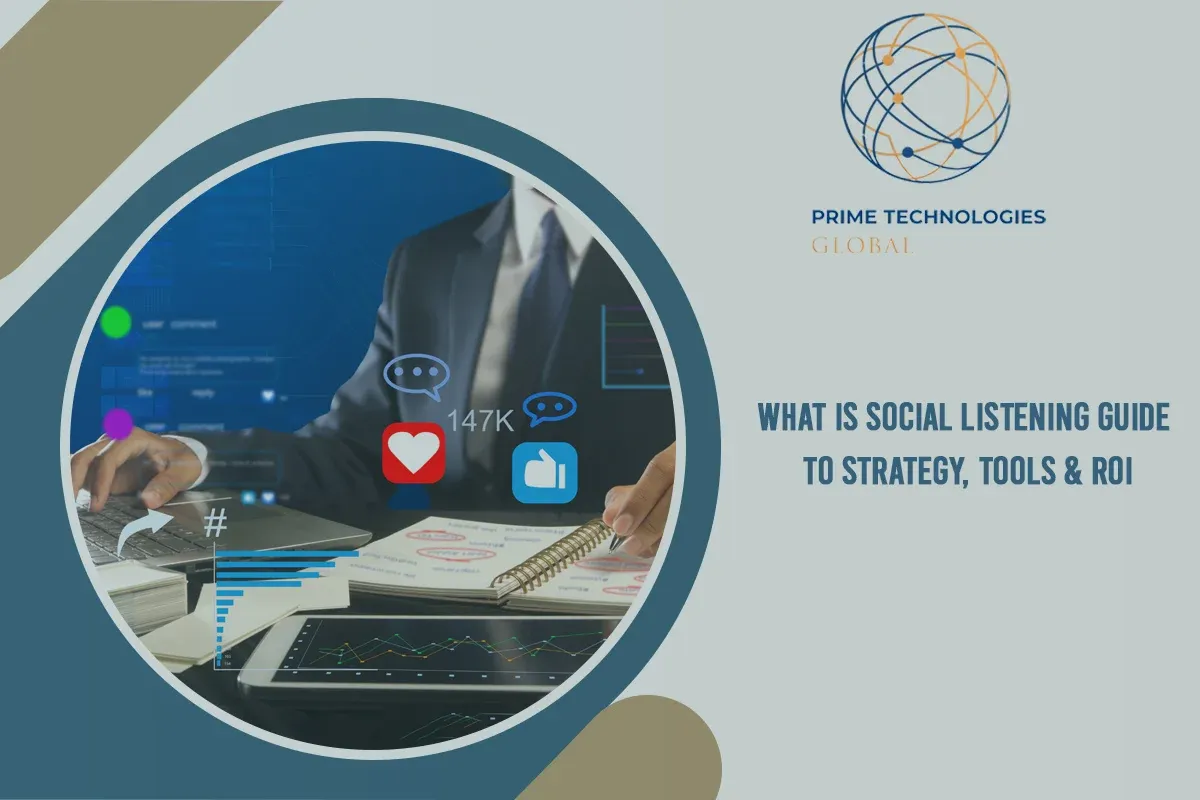
What Is Social Listening? | Guide to Strategy, Tools & ROI
Somewhere right now, a customer is describing your brand in a comment thread you'll never see, a group chat you're not part of, or a TikTok caption that never tags your handle.
Most marketing teams only catch a fraction of that conversation. If your team is limited to replying to @mentions and clearing the inbox, you are managing customer service not social listening.
Social listening is the discipline built to close that gap. It's the difference between knowing what was said to you and understanding what is being said about you, across the entire digital landscape video captions, private communities, review sites, and public timelines alike.
This guide breaks down what social listening is, how it differs from basic social media monitoring, which social listening tools are worth evaluating, how to run a listening program end to end, and how to turn the resulting data into a report leadership actually reads.
What Is Social Listening? Definition and Meaning
The social listening definition, in plain terms: it is the ongoing practice of tracking conversations across the internet, social platforms, forums, review sites, video and audio content and then analyzing that data for sentiment, intent, and emerging patterns so a business can act on what it learns.
So what is social listening in marketing specifically? It's the layer that tells a marketing team why a campaign is landing, why a competitor is losing customers, or why a product category is suddenly trending insight that goes well beyond counting likes or replying to a support ticket.
Understood this way, the social listening meaning extends past the marketing department entirely. Product, customer experience, PR, and sales teams all draw on the same underlying data set, just for different purposes.
Social Media Monitoring vs Social Listening: What's the Real Difference?
Teams frequently use social media listening and social media monitoring interchangeably, but they solve different problems.
Monitoring is reactive; it's built for responding to a direct mention or a support request. Listening is proactive; it's built for spotting a pattern across thousands of untagged conversations before it becomes a headline. The table below lays out the practical distinction.
|
Feature |
Social Media Monitoring |
Social Listening |
|
Focus |
Reactive responding to direct queries |
Proactive analyzing aggregate data |
|
Primary metric |
Volume, tags, and engagement counts |
Sentiment, context, and intent |
|
Core goal |
Resolve immediate customer issues |
Inform long-term brand and product strategy |
|
Scope |
Owned brand channels |
Cross-web, dark social, and industry-wide chatter |
|
Typical owner |
Customer support / community team |
Marketing strategy, product, and PR |

How Does Social Listening Work?
Every mature social listening program runs on the same underlying mechanics, whether it's powered by an enterprise suite or a lean in-house setup.
- Query architecture: the platform is configured with the brand name, common misspellings, executive names, product lines, and competitor terms.
- Aggregation: the tool pulls matching content from public social platforms, forums, review sites, and where privacy-compliant aggregated dark social clusters.
- Multimodal processing: automated speech recognition (ASR) indexes brand mentions spoken aloud in video and podcast content, while optical character recognition (OCR) catches logos that appear on-screen but are never typed or said.
- Sentiment and NLP analysis: natural language processing scores each mention as positive, negative, or neutral, and clusters related conversations into a single narrative thread.
- Insight routing: findings are distributed to the team positioned to act engineering for bugs, sales for competitor weaknesses, content for emerging topics.

Social Listening Tools: What's Actually on the Market
The phrase "social listening tools" covers a wide spectrum, from enterprise suites priced for global brands to lightweight options a solo marketer can run in an afternoon. Here's how the landscape typically breaks down.
Enterprise-Grade Platforms
Suites built for large brands and agencies emphasize multimodal AI, historical data depth, and dark social coverage. These are the platforms most often cited when people search for the best social media listening tools, and they typically come with dedicated account support and custom reporting.
Mid-Market Listening Tools
Mid-market social listening tools bundle listening with publishing and community management, making them a common choice for in-house marketing teams that need one dashboard rather than several.
Lightweight and Native Options
Free or near-free listening tools for social media native platform analytics, alert-based keyword trackers, and browser-based search tools are a reasonable starting point for smaller budgets, though they typically lack multimodal and dark social reach.
What to Look for When Evaluating a Social Listening Tool
- Native multimodal AI can parse spoken audio and on-screen text, not just captions?
- Cross-platform search coverage, including TikTok and YouTube search behavior, not just legacy public timelines.
- Sentiment accuracy for your industry's specific vocabulary and slang.
- Privacy-compliant access to aggregated dark social signals.
- Export and reporting flexibility, so data doesn't stay locked in a proprietary dashboard.
Can You Use ChatGPT for Social Listening?
This comes up constantly, and the honest answer is: partially. ChatGPT and similar large language models are genuinely useful as an analysis layer summarizing a batch of exported comments, drafting a first-pass sentiment read, or turning a messy spreadsheet of mentions into a narrative summary.
What ChatGPT cannot do on its own is function as a listening tool. It does not continuously crawl the web, it does not hold a historical archive of your brand's mentions, and it has no privacy-vetted access to dark social communities. Treat it as a fast way to interpret data a dedicated platform has already collected, not a replacement for the platform itself.
How to Build a Social Listening Strategy
Turning raw chatter into a working social listening strategy comes down to five repeatable steps.
- Define the objective. Are you managing a reputation risk, benchmarking against a named competitor, or scouting content ideas for the next campaign?
- Map the query architecture. Build out the full keyword set: brand name, misspellings, executive names, product lines, and your top three competitors.
- Choose the right tool tier. Match the platform's multimodal and dark social capability to your actual budget and risk profile, rather than defaulting to the most expensive option.
- Segment by sentiment and narrative. Look past raw volume to where a negative cluster is actually originating.
- Route the insight and close the loop. Send product bugs to engineering, competitor gaps to sales, and market anxieties to content then check back in 30 days to see what changed.
Social Listening Best Practices
- Review your keyword list quarterly new slang and product names shift constantly.
- Separate "spike" alerts (sudden volume change) from "drift" alerts (slow sentiment decline); they need different response speeds.
- Combine social media listening and monitoring workflows into one dashboard so support and strategy teams aren't working from different data.
- Benchmark your own sentiment trend against at least one named competitor, not just against your own historical baseline.
The Benefits of Social Listening for Business Growth
The benefits of social listening extend well past the marketing calendar.
- Brand reputation management is an early-warning system that flags a sentiment drop before it becomes a trending story.
- Competitive intelligence pinpointing a rival's product or service weakness directly from their own customers' complaints.
- Product innovation a free, ongoing roadmap sourced from real user workarounds and feature requests.
- Customer experience optimization surfacing the systemic operational issues that reviews and support tickets alone don't fully capture.
- Campaign measurement tracking how a launch is actually landing, not just how many people clicked.

Social Listening Services: Agency vs. In-House Programs
Once a business decides to invest in social listening programs, the next decision is who runs it.
An in-house program keeps institutional knowledge close and works well for a single-brand company with the budget for a dedicated analyst. A social listening agency makes more sense when a brand needs multimodal and dark social coverage without hiring a full internal team, or when the same insight needs to feed several client publications at once.
Social listening services offered by an agency typically include tool licensing, keyword architecture, monthly reporting, and insight routing, effectively the entire five-step strategy handled end to end.
Turning Social Listening Data Into a Report Leadership Actually Reads
Raw social listening data is only useful once it's structured into something a non-specialist can act on. A social listening report that gets read rather than filed away typically includes four elements: a sentiment trend line over the reporting period, the top two or three narrative clusters driving that trend, a benchmark against a named competitor, and a short list of recommended actions tied to a specific owner.
This is also where social media listening and monitoring data should merge into a single view. Support-ticket volume and social sentiment often move together, and separating them into two reports hides the connection leadership most needs to see.
The Strategic Takeaway
Social listening has moved well past a brand-safety checkbox. Done properly, it's the mechanism that lets a business hear its market before that market ever picks up the phone or leaves a review catching a product flaw in an unboxing video, a competitor's weak spot in a complaint thread, or a shift in customer mood weeks before it shows up in a quarterly report.
The businesses getting real value from it aren't the ones with the biggest listening budget; they're the ones who've built a short, repeatable loop from raw conversation to a specific action owned by a specific team. That loop is the actual strategy; the tool is just how you hear the conversation in the first place.
Prime Technologies Global helps brands build listening-informed content and digital strategies from keyword architecture and tool selection to the reporting frameworks that turn raw conversation into measurable growth. If your team is ready to stop guessing and start listening strategically, let's talk. Connect with Prime Technologies Global to build your social listening program.

FAQ’s
What do you mean by social listening?
Social listening means tracking conversations about a brand, industry, or topic across the internet both tagged and untagged and analyzing that data for sentiment and patterns so a business can take action on it. It goes beyond replying to direct mentions to understand the broader context behind a conversation.
What is an example of social listening?
A common example is a brand noticing a cluster of untagged videos showing the same product workaround or complaint, then routing that insight to product or engineering before it ever becomes a formal support ticket catching a pattern the brand was never directly told about.
Can you use ChatGPT for social listening?
ChatGPT can help analyze and summarize data that's already been collected, turning a batch of exported comments into a sentiment summary, for instance. It cannot function as a standalone listening tool, since it doesn't continuously crawl the web or hold a historical archive of brand mentions the way a dedicated platform does.
Is social listening worth it?
For most brands with an active online audience, yes. The return typically shows up as faster crisis response, sharper competitive intelligence, and a steadier stream of product and content ideas sourced directly from real customer conversation, rather than as a single easily-measured line item.