
Serverless Architecture in 2026: A Practical Guide to Modern Cloud Scalability
The Benefits of Serverless Architecture in React Mobile App Development
Key Takeaways
- Serverless architecture eliminates server provisioning: AWS Lambda, Google Cloud Functions, and Azure Function App execute code only when triggered.
- Cold starts remain the primary latency risk in 2026; provisioned concurrency and edge caching are the remediation standards.
- AWS Lambda holds approximately 70% of the FaaS market; the Serverless Framework enables multi-cloud deployment from a single YAML config.
- Serverless is cost-optimal for spiky, unpredictable trafficbut incurs steep per-invocation costs at sustained high-volume throughput.
- Secret management has moved beyond environment variables; Cloud Secret Manager and IAM least-privilege roles are the 2026 compliance baseline.
Cloud bills do not lie. For teams running lightly-used APIs, event pipelines, or scheduled batch jobs on always-on EC2 or GKE nodes, idle compute is the single largest line item. Serverless architecture solves this by charging only for actual execution timemeasured in millisecondswhile the cloud provider absorbs every hardware, OS-patch, and capacity-planning concern underneath.
This guide is written for developers and technical decision-makers who need execution-level detail, not a definition glossary. It covers what serverless architecture is, how to build serverless architecture on AWS and Google Cloud Platform, when to use it, andcriticallywhen to walk away.

The Anatomy of Modern Serverless Systems
What Is Serverless Architecture?
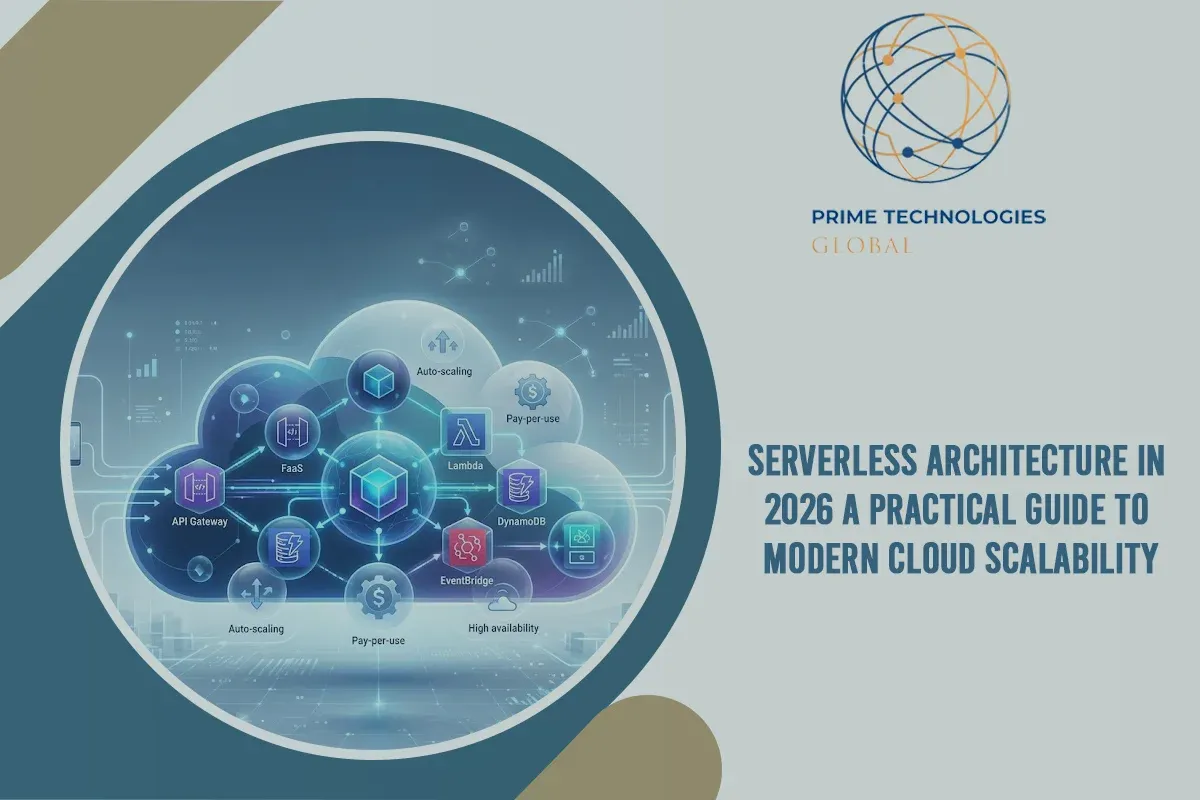
Serverless architecture is an event-driven execution model in which the cloud provider dynamically allocates compute in response to a trigger, runs the function, and immediately reclaims resources. The developer ships only application logicno AMIs, no Dockerfiles, no Kubernetes manifests.
Four core components make up any serverless system: Trigger sources (HTTP request, S3 upload, Pub/Sub message, Cron schedule), Function runtime (Python 3.12, Node.js 20, Go 1.22), API Gateway integration (routes HTTP traffic to function endpoints), and Managed backing services (DynamoDB, Firestore, Cloud Storage).

The Event-Trigger Mechanism
Every serverless function begins with an event contract. AWS Lambda, for example, accepts over 200 event source types natively. The three most architecturally relevant are:
- HTTP/HTTPS via API Gateway integration: A REST or WebSocket request hits an API Gateway endpoint, which invokes the Lambda function synchronously and proxies the response back to the caller.
- Asynchronous object events: An S3 PUT triggers image resizing or ETL processing. The function is invoked asynchronously API Gateway is not in the path.
- Scheduled events (Cron): EventBridge (formerly CloudWatch Events) invokes functions on a defined schedule, replacing cron daemons on EC2.
The 2026 Optimization Strategy: Zero-Cold-Start Architecture
Cold starts the latency penalty incurred when a provider must initialize a new execution environmentremain the primary performance risk. In 2026, two mitigation strategies have become standard:
- Provisioned Concurrency (AWS Lambda / Google Cloud Functions): Pre-initializes a set number of execution environments. Eliminates cold starts entirely for that concurrency level. Cost: You pay for idle provisioned environments at a discounted rate (~$0.015/GB-hour on Lambda).
- Edge Caching via CDN: For read-heavy API patterns, caching responses at AWS CloudFront or Google Cloud CDN edge nodes removes the function invocation entirely for cache-hit requests, reducing both latency and per-invocation cost.
- Runtime Selection: Compiled languages (Go, Rust via custom runtime) have initialization times 60-80% lower than interpreted languages (Python, Node.js) for identical function complexity. Choose runtime based on cold-start tolerance, not team preference alone.

Top Providers: AWS Lambda & Serverless Framework vs. Google Cloud Functions vs. Azure Function App
AWS Lambda & Serverless Framework
AWS Lambda dominates the FaaS market with approximately 70% share, driven by the depth of its ecosystem (200+ event sources, VPC integration, Lambda Layers for shared dependencies) and the Serverless Frame worka open-source toolchain that abstracts provider-specific configuration into a single serverless.yml file.
The Serverless Framework's value proposition in a multi-cloud deployment is concrete: one YAML configuration file deploys the same function logic to Lambda, Google Cloud Functions, or Azure Function App by switching a provider: block. For organizations managing functions across providers, this eliminates divergent CI/CD pipelines.
Google Cloud Functions & Google Cloud Platform
Google Cloud Functions v2 (now backed by Cloud Run) offers tighter native integration with the Google Cloud Platform ecosystem than any competing service. The critical differentiator is BigQuery and Vertex AI integration: a Cloud Function can stream-write to BigQuery with no additional middleware, and trigger Vertex AI model inference directly via the AI Platform APImaking it the preferred execution layer for ML inference pipelines.
Google Cloud Functions also supports HTTP functions and background functions triggered by Pub/Sub, Cloud Storage events, or Firestore document changes.
Provider Comparison Matrix
|
Feature |
AWS Lambda |
Google Cloud Functions v2 |
Azure Function App |
|
Max Execution Time |
15 minutes |
60 minutes (HTTP), unlimited (background) |
230 seconds (Consumption), unlimited (Premium/Dedicated) |
|
Language Support |
Python, Node.js, Go, Java, Ruby, .NET, custom runtime |
Python, Node.js, Go, Java, Ruby, PHP |
Python, Node.js, Go, Java, C#, PowerShell |
|
Cold Start (typical) |
100–500ms (Python/Node.js) |
80–400ms (Python/Node.js) |
200–600ms (Python/Node.js) |
|
Free Tier / Month |
1M requests, 400K GB-seconds |
2M invocations, 400K GB-seconds |
1M requests, 400K GB-seconds |
|
Native Event Sources |
200+ (S3, DynamoDB, Kinesis, SQS...) |
Cloud Storage, Pub/Sub, Firestore, HTTP |
Blob Storage, Event Grid, Service Bus, HTTP |
|
Best Integration |
Broad AWS ecosystem (RDS Proxy, EFS, X-Ray) |
BigQuery, Vertex AI, GKE Autopilot |
Azure AD, Cosmos DB, Logic Apps |
|
Multi-Cloud Support |
Via Serverless Framework |
Via Serverless Framework / Terraform |
Via Serverless Framework / Terraform |
When to Use Serverless Architecture (and When to Walk Away)
Green Light: Optimal Serverless Use Cases
Serverless architecture delivers the best ROI under these conditions:
- Unpredictable or spiky traffic: Event-driven APIs, webhook receivers, and seasonal workloads (e.g., e-commerce checkout spikes) pay only for actual execution. An idle function costs exactly $0.
- Chatbots and conversational AI: Low-concurrency, high-latency-tolerance workloads where per-session function invocations are short and infrequent.
- Image and video processing pipelines: S3-triggered Lambda functions for thumbnail generation, format conversion, or metadata extraction are the canonical serverless pattern.
- CI/CD pipeline automation: Lightweight build triggers, test runners, and deployment hooks executed on code push events.
- Scheduled data aggregation: Nightly ETL jobs, report generation, and database cleanup tasks running 1–5 minutes per execution on a Cron schedule.

Yellow Light: When to Evaluate Carefully
Cost at scale is the most frequently underestimated serverless failure mode. The per-invocation pricing model inverts economics at sustained high throughput:
At 10 million invocations/month at 1 second average duration (512 MB), AWS Lambda costs approximately $16.70/month after the free tier. At 1 billion invocations/month with the same profile, cost reaches ~$1,670/month, often 3–5x the equivalent Kubernetes node cost.
Vendor lock-in is the second risk. AWS event source mappings, Lambda Layers, and IAM execution roles are non-portable constructs. Migrating a production Lambda-heavy architecture to Google Cloud Functions is a rewrite, not a lift-and-shift.
Microservices vs. Serverless: Strategic Comparison
|
Dimension |
Microservices (Containerized) |
Serverless (FaaS) |
|
Architecture Type |
Design pattern (how services are structured) |
Execution model (how code runs) |
|
Infrastructure Control |
Full (you manage containers, networking, scaling) |
None (provider-managed) |
|
Cost Model |
Pay-per-resource (vCPU/RAM/hour) |
Pay-per-invocation (GB-second) |
|
Cold Start Risk |
None (always-on containers) |
Yes (mitigated with provisioned concurrency) |
|
Operational Overhead |
High (Kubernetes, service mesh, observability stack) |
Low (provider handles OS, patching, scaling) |
|
Max Request Duration |
Unlimited |
Up to 60 minutes (varies by provider) |
|
Best For |
Sustained high-traffic services, stateful workloads |
Event-driven, bursty, stateless workloads |
Security & Management: Beyond the API Key
How to Use an API Key Securely (and Why Environment Variables Are No Longer Sufficient)
Hardcoded API keys in function source code are an obvious vulnerability. Environment variablesthe common next stepare an improvement but carry their own risks: they are visible in plaintext in the Lambda console, logged in CloudTrail configuration events, and readable by any principal with lambda: GetFunctionConfiguration permission.
The 2026 standard for secret management in serverless environments is retrieval at runtime from a dedicated secret store, with the key never appearing in the function's environment configuration:
- AWS Secrets Manager: Secrets are stored encrypted at rest (AES-256) and retrieved via SDK call at function initialization. Rotation is automated via a built-in Lambda rotator.
- Google Cloud Secret Manager: Equivalent service on Google Cloud Platform. Access is gated by IAM bindings at the secret version levelnot the project level.
- HashiCorp Vault: Provider-agnostic option for multi-cloud environments; adds operational overhead but eliminates provider-specific dependencies.
Principle of Least Privilege: IAM Role Isolation
A common misconfiguration in serverless deployments is sharing a single IAM execution role across multiple functions. This violates the Principle of Least Privilege: a compromise of any one function grants an attacker the permissions of every function sharing that role.
The correct pattern: each Lambda function receives its own IAM role with only the specific permissions required for its operation. For a function that reads from S3 and writes to DynamoDB, the role policy grants s3:GetObject on the specific bucket ARN and dynamodb: PutItem on the specific table ARNnothing broader.
Observability: Monitoring Distributed Function Execution
Stateless, ephemeral functions make traditional server-centric monitoring irrelevant. The correct observability stack for serverless in 2026 combines:
- Distributed tracing: AWS X-Ray or Google Cloud Trace injects trace IDs across function invocations, API Gateway calls, and downstream service calls, reconstructing the full execution path for any request.
- Structured logging: JSON-formatted logs with correlation IDs sent to CloudWatch Logs or Google Cloud Logging enable log aggregation and querying across thousands of concurrent executions.
- Anomaly detection: Datadog Serverless or AWS Lambda Insights surface P99 latency, error rate, and throttle metrics with function-level granularity.
Advanced Implementation: Step-by-Step Deployment
How to Build Serverless Architecture: 4-Step Deployment Flow
The following steps deploy a Python Lambda function triggered by API Gateway integration using the Serverless Framework:
- Step 1: Write the Function Logic
# handler.py
import json
def hello(event, context):
name = event.get('queryStringParameters', {}).get('name', 'World')
return {
'statusCode': 200,
'headers': {'Content-Type': 'application/json'},
'body': json.dumps({'message': f'Hello, {name}!'})
}
- Step 2: Configure serverless.yml
service: hello-api
provider:
name: aws
runtime: python3.12
region: us-east-1
memorySize: 256
timeout: 10
functions:
hello:
handler: handler.hello
events:
- httpApi:
path: /hello
method: GET
provisionedConcurrency: 2 # Zero-cold-start for baseline load
- Step 3: Test Locally
serverless invoke local --function hello --data '{"queryStringParameters":{"name":"Claude"}}'
- Step 4: Deploy
serverless deploy --stage prod
The Serverless Framework packages the function, creates CloudFormation resources (Lambda, API Gateway HTTP API, IAM execution role, CloudWatch log group), and returns the endpoint URL. Total deploy time for a cold stack: 60–90 seconds.
Executive Summary & Comparison
Pros and Cons at a Glance
|
Pros • Zero infrastructure management overhead • Per-millisecond billing: idle cost is $0 • Automatic horizontal scaling to millions of requests • Faster time-to-market for event-driven features • Built-in high availability across multiple AZs • Serverless Framework enables multi-cloud portability |
Cons • Cold start latency (100–600ms without provisioned concurrency) • Execution duration limits (15 min on Lambda) • Cost spikes at sustained high-throughput workloads • Vendor lock-in from proprietary event sources and IAM models • Complex local testing and debugging for event-driven chains • Stateless-by-default requires external state management (DynamoDB, Redis) |
Real-World Impact: Cost Reduction at Scale
Coca-Cola's vending machine platform migrated from an always-on server fleet to AWS Lambda for transaction processing. The result: 65% reduction in infrastructure costs, with the system handling purchase events from 3.5 million machines globally. The event-driven modela purchase triggers a Lambda, which writes to DynamoDB and publishes to SNS, processing unpredictable peak loads (stadium events, morning commutes) without pre-provisioning capacity.
Netflix uses Lambda functions for video encoding pipeline orchestration, media file validation, and real-time stream monitoring tasks that are inherently event-driven and duration-bounded. Their infrastructure team has publicly noted 70–80% cost efficiency gains on these workloads compared to dedicated compute.
Conclusion
Serverless architecture is the correct default for event-driven, stateless, and bursty workloads in 2026. The operational overhead reduction is real: no AMI patching, no cluster autoscaling configuration, no capacity reservation guesswork. The cost model is genuinely better for low-to-medium throughput services.
The ceiling is equally real. At sustained high‑invocation volumes, per‑execution pricing outpaces reserved compute. Execution duration limits disqualify it for long‑running processes. And vendor lock‑in is not theoretical—it is a concrete re‑architecture cost that must be factored into any multi‑year infrastructure decision.
Audit your current cloud bill. Identify services where compute runs continuously but handles requests for less than 30% of that time. Those workloads are serverless candidates. For services with consistent, high‑concurrency traffic profiles, the container or VM model remains the more cost‑efficient choice. The decision is workload‑specific, not architectural dogma.
Frequently Asked Questions
Is Kubernetes a serverless architecture?
No. Kubernetes is a container orchestration platform requiring node and pod management. While tools like Knative enable scale-to-zero capabilities, and GKE Autopilot abstracts infrastructure, the underlying model remains container-centric. It lacks the native, event-driven, function-as-a-service execution model that defines true serverless computing.
Why are we leaving serverless?
Organizations move specific high-throughput workloads to containers to avoid costs at scale. Prime Video famously reduced costs by 90% by shifting a monitoring service from Lambda to ECS, eliminating expensive state-coordination API calls. It’s a strategic cost-optimization for consistent traffic, not a failure.
What is the difference between microservices and serverless architecture?
Microservices is an architectural design pattern for decomposing applications into independent services. Serverless is an execution model for running code via event-driven, managed infrastructure. You can build microservices using serverless functions (FaaS), but you can also run them on containers or virtual machines.
What are the downsides of serverless?
Primary disadvantages include cold start latency, a 15-minute execution cap on platforms like AWS Lambda, and significant vendor lock-in due to provider-specific SDKs. Additionally, testing complex event-driven chains locally is difficult, often requiring specialized third-party tooling like LocalStack to simulate cloud environments.
What are the 4 types of cloud computing?
Cloud models include IaaS (virtualized infrastructure), PaaS (managed runtimes), and SaaS (ready-to-use software). The fourth is FaaS (Function-as-a-Service), or serverless, where providers manage the entire execution environment, triggering individual code snippets only when specific events occur. This offers the most granular scaling.