
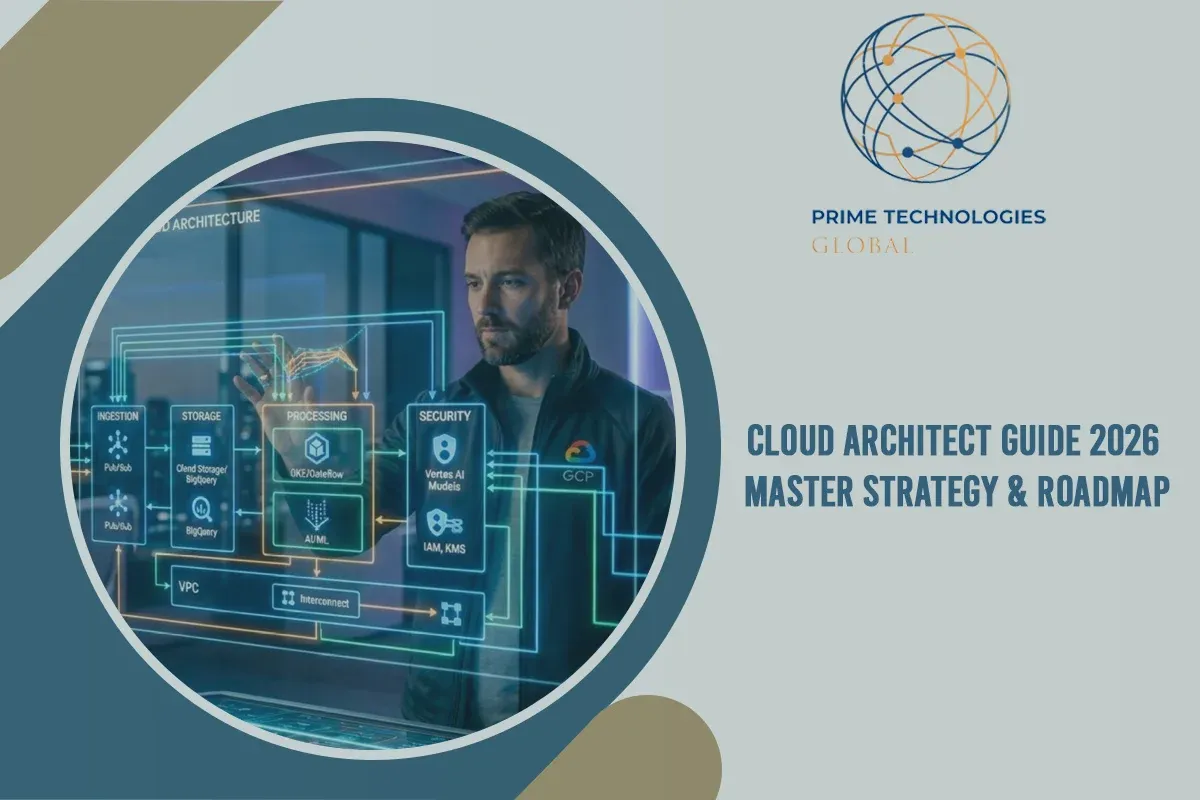
Cloud Architect Guide 2026: Master Strategy & Roadmap
Introduction
The cloud is no longer a storage utility. It is the foundation of every competitive company's operations. And at the center of that backbone sits a role that most organizations still underestimate: the cloud architect.
This article is a direct, experience-driven roadmap. Whether you are asking what a cloud architect is, exploring cloud architect jobs, or evaluating a cloud architect certification path, this guide covers the full scope of responsibilities, career trajectory, design philosophy, and the strategic thinking needed to manage infrastructure on a large scale.
What Exactly Does a Cloud Architect Do?
The cloud architect role is defined by three core accountabilities: translating business requirements into technical specifications, designing systems that are resilient and cost-efficient by default, and leading cross-functional teams through complex migration and modernization initiatives.
This is not a maintenance role. A cloud architect operates at the decision layer, setting the structural logic that cloud engineers will then build and operate.
Core Responsibilities of a Cloud Architect
- Infrastructure Design: Planning the high-level topology of cloud environments, VPCs, subnets, availability zones, load balancers, and service mesh configurations before a single resource is provisioned.
- Security & Compliance Architecture: Embedding IAM policies, encryption standards, audit logging, and regulatory compliance frameworks (SOC 2, ISO 27001, HIPAA) directly into the infrastructure design.
- Migration Roadmapping: Creating phased plans to move legacy on-premises workloads into cloud-native environments using strategies like lift-and-shift, re-platforming, or full re-architecture.
- Cost Governance: Designing FinOps-aligned systems that use Reserved Instances, Spot pricing, auto-scaling, and resource tagging to control cloud spend structurally, not reactively.
- Multi-Cloud Strategy: Evaluating and selecting the right provider mix AWS, Azure, or Google Cloud based on workload requirements, organizational capabilities, and vendor risk posture.
Cloud Architect vs. Cloud Engineer: What Is the Actual Difference?
This distinction matters for career planning, team structure, and organizational hiring decisions. The confusion between these two roles is one of the most common misalignments in technical hiring.
|
Dimension |
Cloud Architect |
Cloud Engineer |
|
Primary Focus |
What to build and why |
How to build it and maintain it |
|
Decision Layer |
Strategic and structural |
Operational and tactical |
|
Key Output |
Architecture diagrams, design documents |
Deployed infrastructure, CI/CD pipelines |
|
Time Horizon |
6–24 month planning cycles |
Sprint-based execution cycles |
|
Core Tools |
Visio, Lucidchart, AWS Well-Architected |
Terraform, Ansible, Kubernetes, CloudFormation |
|
Business Interface |
Direct stakeholder and executive engagement |
Engineering team-level collaboration |
The architect's blueprint enables the engineer to build efficiently. Without a clear architecture, engineers over-engineer, under-provision, and accumulate technical debt that costs multiples to resolve later.

How Do You Become a Cloud Architect? The Professional Development Path
The industry-wide response to the topic of how to become a cloud architect is the same: you start with the infrastructure. Architects who skip foundational roles struggle with the operational empathy required to design systems that engineers can actually build and operate.
Build the Operational Foundation (Years 1–3)
Start in roles that expose you to the physical and logical mechanics of IT infrastructure:
- Systems Administration: Managing servers, storage, and operating systems gives you an intuitive understanding of resource constraints and failure modes.
- Network Engineering: Understanding TCP/IP, DNS, BGP, and routing protocols is non-negotiable. Cloud networking is software-defined, but the logic is identical.
- Software Development or DevOps: Exposure to application architecture informs how you design the infrastructure that those applications run on.
Build Multi-Cloud Technical Competency (Years 3–6)
A credible cloud architect understands the trade-offs between major providers, not just one platform. Focus on:
- AWS (Amazon Web Services): Market leader with the broadest service catalog. AWS Solutions Architect certifications are the de facto baseline credential in cloud architect jobs.
- Microsoft Azure: Dominant in enterprise environments and deeply integrated with Active Directory, Office 365, and hybrid cloud deployments.
- Google Cloud Platform (GCP): Leading in data analytics (BigQuery), Kubernetes-native workloads, and machine learning infrastructure. The Google Professional Cloud Architect certification is highly respected.
- Architecture Principles: Master the AWS Well-Architected Framework's five pillars: Operational Excellence, Security, Reliability, Performance Efficiency, and Cost Optimization.
Earn Strategic Certifications
Cloud architect certifications validate your technical depth and signal credibility to employers and clients. The highest-value credentials in order of market weight:
- AWS Certified Solutions Architect – Professional: The most recognized credential in cloud architect certification pathways globally.
- Google Professional Cloud Architect: Highest value for GCP-heavy environments and data engineering roles.
- Microsoft Certified: Azure Solutions Architect Expert: Essential for enterprise hybrid environments.
- Certified Cloud Security Professional (CCSP): Specialized credential for cloud security architect roles.

|
Pro Tip |
The Cloud Architect's Decision Matrix: How Should You Design for the Modern Business Environment?
Modern enterprise cloud architecture is no longer just a technical SEO discipline; it is a strategic capability. Every design decision has a direct business consequence. The following framework guides how I approach every architecture engagement.
Scalability and Performance Engineering
Design systems that grow with the business, not systems that require a redesign every 18 months. Scalability-first architecture relies on:
- Horizontal Scaling Over Vertical: Distribute load across multiple small instances rather than relying on a single large server. This is the foundation of fault-tolerant cloud design.
- Event-Driven Architecture: Decouple services using message queues (Amazon SQS, Azure Service Bus) and event streams (Apache Kafka, AWS Kinesis) so individual components can scale independently.
- Auto-Scaling Groups and Policies: Define scaling triggers based on CPU utilization, queue depth, or custom CloudWatch metrics, not static schedules.
- Content Delivery Networks (CDNs): Offload static asset delivery to edge nodes (CloudFront, Azure CDN) to reduce origin server load and improve global latency.
FinOps-Aligned Cost Governance
Cloud spend is not a billing problem; it is an architecture problem. Cost optimization is most effective when designed into the system, not managed reactively through alerts and budget cuts.
- Reserved Instances and Savings Plans for baseline workloads with predictable demand.
- Spot and Preemptible Instances for fault-tolerant, stateless batch workloads.
- Resource Tagging Standards: Enforce cost allocation tags at the infrastructure provisioning layer using AWS Service Control Policies or Azure Policy.
- Right-Sizing Automation: Use AWS Compute Optimizer or Azure Advisor to continuously right-size over-provisioned resources.
- Storage Lifecycle Policies: Automatically tier infrequently accessed data to lower-cost storage classes (S3 Glacier, Azure Cool Tier).
Security-by-Design Architecture
Security embedded at the design stage costs a fraction of security bolted on after deployment. Cloud security architecture follows a zero-trust model: no implicit trust, continuous verification, and least-privilege access everywhere.
- Identity and Access Management (IAM): Define granular role-based access control policies at the resource level. Never do operational activities with root credentials.
- Network Segmentation: Separate workloads into dedicated VPCs with private subnets, security groups, and network ACLs that limit blast radius in breach scenarios.
- Encryption at Rest and in Transit: Enforce TLS 1.2+ for all data in transit. Use KMS-managed keys for data at rest with automatic key rotation policies.
- Audit and Compliance Logging: Enable AWS CloudTrail, Azure Monitor, or GCP Cloud Audit Logs from day one, not as an afterthought during a compliance review.
- Infrastructure as Code (IaC) Security Scanning: Integrate static analysis tools like Checkov or tfsec into CI/CD pipelines to catch misconfigurations before deployment.
What Does a Cloud Architect Earn? Salary and Market Positioning
Cloud architect salary is among the highest in the technology sector, reflecting the strategic accountability that comes with the role. Compensation varies significantly by specialization, geography, and cloud platform expertise.
|
Role |
Experience Level |
Typical Annual Range (USD) |
|
Cloud Solutions Architect |
Mid-Level (3–6 years) |
$120,000 – $160,000 |
|
Cloud Solutions Architect |
Senior (6–10 years) |
$160,000 – $200,000 |
|
Cloud Security Architect |
Senior (6–10 years) |
$170,000 – $220,000 |
|
Cloud Architect Consultant |
Independent (10+ years) |
$180,000 – $280,000+ |
|
Principal / Staff Cloud Architect |
Staff Level (10+ years) |
$200,000 – $300,000+ |
Cloud security architect salary commands a premium above general cloud architect roles due to the specialized expertise in compliance frameworks, threat modeling, and zero-trust design. Cloud solutions architect salary at the principal level in major tech hubs (San Francisco, Seattle, New York) frequently exceeds $250,000, inclusive of equity compensation.
Cloud architect consultant rates vary by engagement model. Project-based consultants often bill $150–$300/hour, while embedded fractional cloud architect services pricing is typically structured as monthly retainers ranging from $8,000 to $25,000, depending on scope.

Is Cloud Architecture Hard to Learn? An Honest Assessment
Cloud architecture is not a hard concept to understand, but it is demanding to execute with the depth required for production-grade systems. The challenge is not the technology. The challenge is developing the judgment to make the right trade-offs under real business constraints.
What Makes Cloud Architecture Genuinely Difficult
- Cross-Domain Knowledge Requirements: You must hold simultaneous competence in networking, security, compute, storage, data engineering, and cost management. No other IT role has this breadth.
- The Speed of Platform Evolution: AWS alone releases hundreds of new features annually. Staying current is a full-time discipline, not a weekend activity.
- The Stakeholder Translation Problem: Technical accuracy is not sufficient. You must communicate architecture decisions to CFOs, legal teams, and product managers in language that connects to their priorities.
- Production Failure Ownership: Unlike development roles, architecture failures manifest at scale, and you own the design decisions that led to them.
The architects who succeed are not the ones who know every AWS service. They are the ones who know which service to use, when not to use it, and how to make that decision defensible to a business audience.
Conclusion
The cloud architect has evolved from a mere technical specialist into the pivotal strategic driver of modern business. Businesses that don't give this design layer top priority have unsustainable cloud expenses, operational complexity, and avoidable security breaches.
As automation streamlines infrastructure maintenance, the expert architect’s focus will shift toward innovative AI integration, edge computing, and autonomous governance. Master these high-level disciplines now to command the future of infrastructure and deliver unrivaled value to your enterprise.
Frequently Asked Questions
What exactly does a cloud architect do?
A cloud architect designs the structural blueprint of cloud environments. This involves defining network topology, compute resources, and storage, while ensuring security, compliance, and cost-efficiency align perfectly with overall business strategy goals.
Is a cloud architect a high-paying job?
Indeed, it is regularly listed as one of the highest-paying positions in technology. Senior-level architects frequently earn between $160,000 and $220,000 annually, with principal roles and specialized security positions often exceeding $250,000, including equity compensation.
Does being an architect take seven years?
While there is no fixed timeline, 5–8 years of progressive IT experience is a realistic benchmark. Foundational years in systems administration, networking, or development build the operational depth required for excellent architectural design.
What does a cloud architect earn?
Earnings typically range from $120,000 for mid-level roles to over $300,000 for principal positions. Cloud security architects often command a 10–20% premium due to specialized expertise in compliance, threat modeling, and zero-trust design.
Is Cloud Architecture hard to learn?
Architecture is broad but learnable through a structured approach. The true challenge is not technical mastery, but developing the judgment to make defensible trade-offs and effectively communicating those decisions to non-technical stakeholders.