
Security Testing Web Application: Best Practices Guide
A single unpatched flaw in a web application can hand an attacker access to a customer database, a payment system, or an internal network. Verizon's 2026 Data Breach Investigations Report found that exploitation of vulnerabilities now accounts for 31% of breach initial-access vectors, up from 20% the year before and overtaking stolen credentials for the first time in the report's 19-year history.
Security testing web application programs exist to close that gap. This guide breaks down what the discipline covers, the testing methods that matter most, and the practices that keep a production environment defensible instead of exposed.
|
KEY TAKEAWAY Security testing web application work is no longer optional due diligence; it's the control that determines whether a known flaw gets fixed before an attacker finds it, or after. |
What Is Web Application Security Testing?
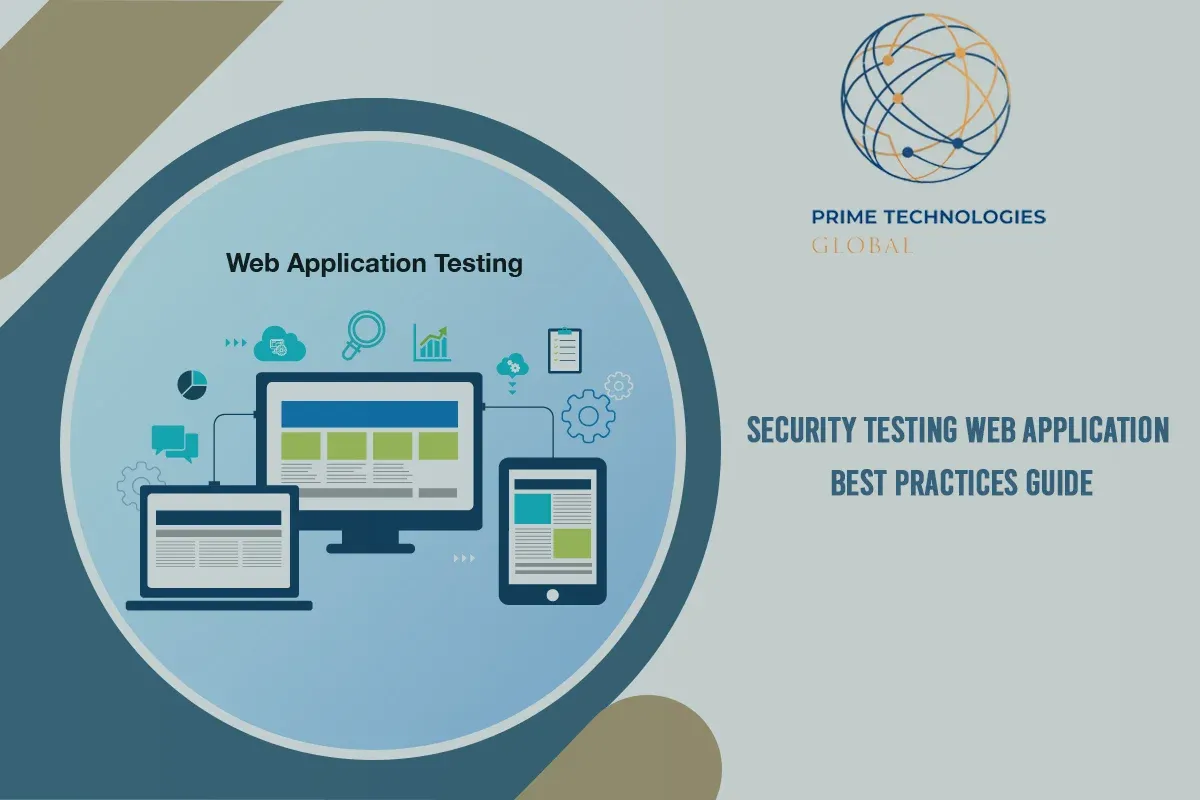
Web application security testing is a non-functional testing process that evaluates how an application withstands unauthorized access, data leakage, and exploitation. Unlike functional QA, it doesn't ask whether a feature works, it asks whether that feature can be abused.
This form of web application assessment sits alongside functional and performance testing, but it answers a different question: can this system be broken into, and what happens if it is.
Core objectives
- Identify security flaws and business-logic vulnerabilities, including OWASP Top 10 issues such as SQL injection, cross-site scripting (XSS), and broken access control
- Confirm compliance with regulatory frameworks such as PCI-DSS, GDPR, and HIPAA
- Protect the CIA triad confidentiality, integrity, and availability of application data
- Surface misconfigurations and outdated dependencies before they reach production
Why Security Testing for Web Based Application Programs Matters
A breach rarely stays contained to the system it started in. Regulatory fines, incident response costs, customer churn, and reputational damage compound well past the initial technical fix.
Security testing for web based application environments specifically matters because browsers, APIs, and third-party integrations expose a far larger attack surface than internal tooling. Every public-facing form, login page, and API endpoint is a potential entry point, and attackers only need one that was never assessed.
Treating web application testing as a compliance checkbox rather than a continuous discipline is the single most common reason vulnerabilities linger long enough to be exploited.

Types of Web Application Testing for Security
Testing of web based applications isn't one activity, it's a set of complementary methods, each catching different classes of issues at different stages of the software development life cycle (SDLC).
Static Application Security Testing (SAST)
SAST is white-box testing that analyzes source code, bytecode, or binaries from the inside out, without executing the application. It runs earliest in the SDLC typically at code commit so developers can fix flaws before they're ever deployed.
Dynamic Application Security Testing (DAST)
DAST is black-box testing that evaluates a running application from the outside, simulating the attack vectors a real adversary would use. It's most valuable in staging and pre-production, where the app behaves the way it will in the real world.
Interactive Application Security Testing (IAST)
IAST is a hybrid approach: instrumentation agents run inside the application while DAST or manual testing executes against it, combining the code-level visibility of SAST with the real-world context of DAST.
Penetration Testing
Penetration testing puts ethical hackers in the attacker's seat. Manual pen testers find the novel, multi-step, business-logic flaws that automated scanners consistently miss a chained exploit across three low-severity bugs, for instance.
Vulnerability Scanning
Automated vulnerability scanning checks an application against known signature databases, establishing a fast, repeatable security baseline. It's a starting point, not a substitute for deeper testing.
Software Composition Analysis (SCA)
SCA scans open-source dependencies and third-party libraries for known CVEs. Given how much of any modern codebase is third-party, this is often where the highest volume of exploitable risk actually lives.
|
Testing Type |
Approach |
Best SDLC Stage |
Primary Strength |
|
SAST |
White-box, static |
Code commit / build |
Catches flaws before deployment |
|
DAST |
Black-box, dynamic |
Staging / pre-production |
Simulates real attack vectors |
|
IAST |
Hybrid, instrumented |
QA / integration testing |
Code-level context on live traffic |
|
Penetration Testing |
Manual, adversarial |
Pre-release / periodic |
Finds complex business-logic flaws |
|
Vulnerability Scanning |
Automated, signature-based |
Continuous |
Fast, repeatable baseline |
|
SCA |
Automated, dependency-based |
Build / continuous |
Flags known CVEs in third-party code |

Manual Testing of Web Based Applications vs. Automated Tests for Web Applications
Automated tests for web applications vulnerability scanners, SAST, and SCA tools scale well. They run on every commit, cover broad ground fast, and catch known issues cheaply. What they can't do is reason about intent: whether a workflow can be manipulated in a way its designers never anticipated.
Manual testing of web based applications, led by experienced penetration testers, fills that gap. A skilled tester chains together minor issues, tests authorization logic the way a real user with malicious intent would, and validates findings that automated testing tools for web applications tend to flag as false positives.

|
EXPERT TIP Run automated testing tools for web applications continuously in the pipeline, and reserve manual, human-led penetration testing for pre-release milestones and periodic deep assessments. Neither approach alone is sufficient. |
Best Practices for Testing Web Applications
- Adopt a DevSecOps approach and shift left. Integrate automated SAST and SCA tools directly into CI/CD pipelines so developers fix issues at build time, not right before release.
- Combine manual and automated testing. Use automation for rapid, repeatable scanning, and rely on human penetration testers for nuanced business-logic errors and multi-step exploits.
- Test continuously, not annually. Move from periodic, check-the-box audits to continuous security monitoring that catches vulnerabilities introduced by rapid deployment cycles.
- Maintain an updated asset inventory. Track every API, microservice, third-party library, and endpoint unmonitored shadow IT is one of the most common sources of unassessed attack surface.
- Prioritize remediation by risk. Score vulnerabilities using CVSS and business impact together, rather than attempting to fix every low-severity finding on the same timeline.
|
COMMON MISTAKE Treating a single annual penetration test as "done." A test result is a snapshot of new code, new dependencies, and new configurations that start generating fresh risk the moment it's delivered. |

How to Test a Web Application: A Step-by-Step Approach
The exact tooling varies by organization, but a defensible sequence for testing web application security looks the same across most mature programs:
- Scope the assessment and inventory of every asset pages, APIs, microservices, and third-party integrations.
- Build a threat model to identify the data and workflows an attacker would target first.
- Run SAST during development, so flaws are caught at commit time.
- Run DAST and automated vulnerability scanning against staging once the build is deployable.
- Run SCA against every dependency to catch known CVEs in third-party code.
- Commission manual penetration testing for business-logic and chained-exploit risk before major releases.
- Score and remediate findings by CVSS and business impact, then retest to confirm the fix holds.
- Move into continuous monitoring so the next code change is assessed automatically, not on next year's audit.
The 7 Pillars of QA: How They Apply to Security Testing
"7 pillars of QA" is commonly used online to refer to the widely recognized Seven Principles of Software Testing, an ISTQB-aligned framework that underpins both functional QA and security testing:
- Testing shows the presence of defects it cannot prove an application is defect-free
- Exhaustive testing is impossible coverage has to be prioritized by risk
- Early testing saves cost and time the earlier a flaw is caught in the SDLC, the cheaper it is to fix
- Defects cluster a small number of modules typically account for most vulnerabilities
- Repeating the same tests stops finding new bugs the so-called pesticide paradox
- Testing is context-dependent a fintech app and a marketing site warrant different testing intensity
- Absence of errors is a fallacy a clean scan doesn't guarantee the application meets user or business needs
Building a Security Testing Program That Holds Up
Security testing web application programs work best as a continuous discipline rather than a once-a-year event, layering SAST, DAST, SCA, and manual penetration testing across the SDLC so that risk gets caught at the cheapest possible point to fix it. The organizations that treat this as infrastructure, not overhead, are the ones that keep pace as both application complexity and attacker tooling accelerate.
Prime Technologies Global builds and manages exactly this kind of layered testing program combining automated pipeline scanning with hands-on penetration testing and compliance-ready reporting, so security testing stops being a once-a-year scramble and becomes a standing part of how software ships. Contact Prime Technologies Global to assess your current testing coverage and close the gaps before an attacker finds them.