
SaaS Application Development: Build Scalable Cloud Products
Building a Software-as-a-Service product is fundamentally different from shipping a one-off piece of software. A SaaS application has to serve thousands of customers from a single codebase, stay online while you deploy new code, and hold up under compliance audits that most internal tools never face. Get the architecture wrong in month one, and you will spend years paying interest on that debt.
This guide walks through the full arc of SaaS application development from validating the idea through choosing a SaaS tech stack, building the product, pricing it, and hardening it for enterprise buyers. Whether you are evaluating SaaS development services for the first time or refining an in-house SaaS app development process, the goal here is the same: give you a working mental model of how experienced SaaS developers actually build durable cloud products.
Understanding the Core of SaaS Architecture
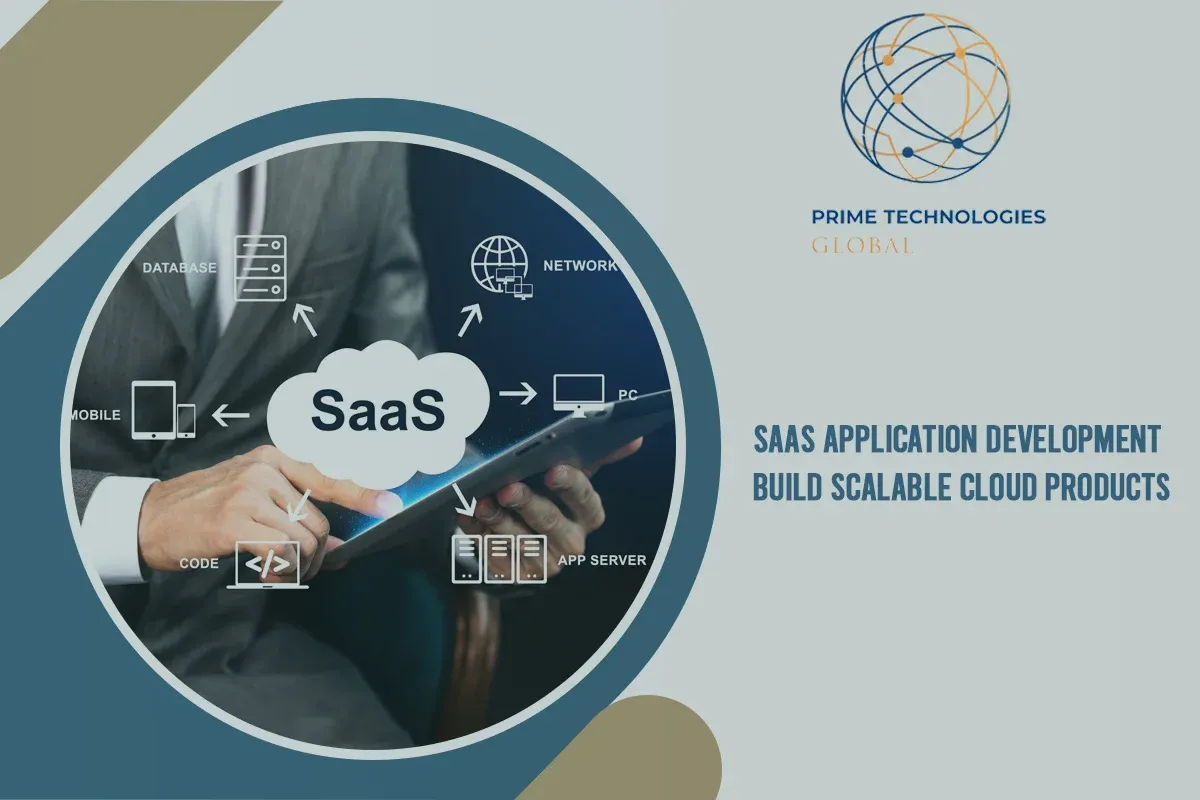
SaaS application development is the process of designing, building, and operating software that customers access over the internet on a subscription basis, rather than installing and maintaining it themselves. The provider owns the infrastructure, the updates, and the uptime; the customer just logs in.
That single shift of infrastructure ownership moving from customer to vendor is what separates SaaS software development from traditional on-premise software, and it's why the discipline has its own set of architectural rules.

From Monolith to Microservices
Early-stage SaaS platform development often starts with a monolith: one codebase, one deployable unit, one database. It's faster to ship. But as a product scales past a handful of engineers, that same monolith becomes the bottleneck every deployment risks breaking every feature.
Most mature SaaS applications development teams eventually decompose the monolith into microservices: independently deployable units (billing, auth, notifications, core product logic) that communicate over APIs. This isn't a requirement for launch, it's a milestone you architect toward.
Single-Tenant vs. Multi-Tenant Architecture
This is the single most consequential decision in custom SaaS development.
- Single-tenant architecture: each customer gets a dedicated instance of the application and database. Maximum isolation, higher infrastructure cost, harder to scale to thousands of customers.
- Multi-tenant architecture: multiple customers (“tenants”) share the same application infrastructure and, typically, the same database with logical isolation enforced at the data layer so no tenant can see another's records.
Industry analysts including Gartner have repeatedly flagged multi-tenant cloud environments as the default target for enterprise workload migration, citing lower total cost of ownership and faster provisioning compared to dedicated infrastructure. Any serious SaaS developer roadmap should treat multi-tenancy as the default, with single-tenant carve-outs reserved for regulated industries like healthcare or government.
Validating Your SaaS Idea and Defining the MVP
Before a single line of production code gets written, the highest-leverage work in SaaS product development happens on paper: validating that the problem is real and that people will pay to have it solved.
The Danger of Building in a Vacuum
It's tempting to jump straight into development once you know how to build a SaaS application technically. But the CB Insights post-mortem research on startup failure consistently ranks “no market need” as the single most common reason tech startups fail well ahead of running out of cash or losing to competitors.
Before scoping any SaaS app development work, run a structured validation pass:
- Competitive analysis: who already solves this problem, even partially, and where do they fall short?
- Audience research: Talks to 15–20 prospective users before writing a spec. Patterns emerge fast.
- Value proposition test can you state, in one sentence, the specific pain point your software removes?

Scoping the Minimum Viable Product (MVP)
Once the value proposition is validated, the next question every founder or product lead faces is how to develop a SaaS application without over-building. The answer is a disciplined Minimum Viable Product (MVP): the smallest version of the product that lets real users generate real usage data.
A well-scoped MVP typically includes:
- Core workflow functionality (the one job the product must do well)
- Basic user authentication and account management
- A single, clear onboarding path
- Minimal but functional billing/subscription handling
Everything else advanced reporting, integrations, white-labeling, granular permissions belongs in the post-MVP roadmap.
Choosing the Right SaaS Tech Stack
The SaaS tech stack you choose in month one has a way of outliving your original plans for it. Migrating a production database or swapping a backend framework after you have paying customers is expensive and risky, so this decision deserves real scrutiny.
Frontend
Modern SaaS web application development typically leans on component-based frameworks React, Vue.js, or meta-frameworks like Next.js chosen for a balance of developer velocity, rendering performance, and ecosystem maturity. The right choice depends less on trend and more on your team's existing depth and the product's rendering needs (heavily interactive dashboards vs. content-driven marketing pages).
Backend and Database
|
Layer |
Common Options |
Best Suited For |
|
Backend runtime |
Node.js, Python (Django/FastAPI), Go |
API-heavy, real-time, or high-concurrency products |
|
Relational database |
PostgreSQL, MySQL |
Structured data, complex relationships, strong consistency |
|
Non-relational database |
MongoDB, DynamoDB |
Unstructured or rapidly evolving data models |
|
Caching layer |
Redis, Memcached |
Session data, rate limiting, reducing database load |
Cloud Infrastructure
The three dominant providers Amazon Web Services (AWS), Microsoft Azure, and Google Cloud Platform (GCP) each offer managed services purpose-built for SaaS cloud application development: managed Kubernetes, managed Postgres, identity services, and auto-scaling compute. The specific provider matters less than committing to one and building around its managed services rather than fighting them.
The SaaS Application Development Lifecycle: Step by Step
This is where the plan becomes software. Experienced SaaS developers follow a fairly consistent lifecycle, regardless of the specific stack.
Step 1: UI/UX Design
Self-service products live or die on onboarding. If a new user can't reach their first meaningful result inside a few minutes, they churn before your sales team even knows they existed. Design the onboarding flow and core dashboard before writing backend logic it will shape your data model.
Step 2: Agile Development
Most teams doing serious SaaS application development services work run Scrum or Kanban, shipping in short iterations rather than waiting for a “big bang” launch. This matters more in SaaS than in shipped software because the product is a living service. Every sprint is really a small negotiation between new features and platform stability.
Step 3: CI/CD Pipelines
Continuous Integration and Continuous Deployment (CI/CD) pipelines automate testing and let a team push updates without taking the product offline. For any team doing SaaS software development at scale, this isn't optional tooling; it's the mechanism that lets you ship dozens of times a week without your on-call engineer dreading Fridays.
Step 4: API-First Development
Designing your core product around well-documented APIs rather than treating the API as an afterthought multiplies the product's value. It's what lets customers connect your SaaS platform to their existing stack, and it's frequently the difference between a tool people tolerate and a platform people build around.
Essential SaaS Metrics and Pricing Models
A technically excellent product built on the wrong pricing model still fails commercially. SaaS metrics exist to catch that mismatch early.
Choosing a Pricing Strategy
- Tiered pricing feature-gated plans (Starter/Pro/Enterprise); the most common model for B2B SaaS.
- Usage-based (metered) pricing customers pay proportional to consumption; common in infrastructure and API-driven products.
- Freemium a free tier drives top-of-funnel adoption, with paid tiers unlocking depth.
- Flat-rate pricing one price, one feature set; simplest to sell, hardest to scale with customer value.
The Metrics That Actually Matter
|
Metric |
What It Measures |
Why It Matters |
|
MRR / ARR |
Monthly / Annual Recurring Revenue |
The core health signal of the business |
|
CAC |
Customer Acquisition Cost |
What it costs to win a paying customer |
|
LTV |
Customer Lifetime Value |
Total revenue a customer generates over their lifecycle |
|
Churn Rate |
% of subscribers who cancel in a period |
Direct signal of product-market fit and retention health |
Churn deserves particular attention in any SaaS product development roadmap, because even a modest monthly churn rate compounds into a serious growth ceiling over a year of subscriptions.
Security, Compliance, and Future Scaling
Enterprise buyers will ask about security before they ask about features. Getting this layer right isn't a launch-week checkbox, it's ongoing infrastructure.
Compliance Frameworks
Depending on industry and geography, SaaS application development services frequently need to account for:
GDPR: Data protection and privacy for EU users
HIPAA: Protected health information, for healthcare-adjacent products
SOC 2 Type II: An audit standard covering security, availability, and confidentiality controls over a sustained period, increasingly a baseline requirement for selling into enterprise accounts
Security Best Practices
- Encryption at rest and in transit: Non-negotiable baseline for any product touching customer data
- Multi-Factor Authentication (MFA): Dramatically reduces account-takeover risk
- Role-Based Access Control (RBAC): Ensures users and admins only reach the data and actions their role requires
Planning for Scale
Auto-scaling groups and load balancers let infrastructure expand and contract with real traffic, rather than being permanently over-provisioned “just in case.” This is where the multi-tenant architecture decision from Section 1 pays off shared infrastructure scales far more efficiently than a fleet of single-tenant deployments.

Conclusion
Successful SaaS application development is less about any single technical decision and more about the compounding effect of good ones: a validated MVP, a tech stack chosen for the product's actual needs, a multi-tenant architecture built for scale, and security posture treated as infrastructure rather than an afterthought. Teams that get this sequence right build products that don't just attract their first hundred users they retain their thousandth.
Partner with Prime Technologies Global
Turning a SaaS concept into a market-ready product takes an engineering team fluent in cloud scalability, multi-tenant architecture, and enterprise security compliance, not just a team that can write code. At Prime Technologies Global, we provide end-to-end SaaS application development services: MVP scoping, SaaS tech stack selection, cloud infrastructure design, API-first architecture, and SOC 2-ready security practices.
Whether you're validating your first MVP or scaling an existing platform to enterprise customers, our SaaS developers build the technical foundation your business needs to grow. Contact Prime Technologies Global to discuss your project.
FAQ’s
What is SaaS application development?
SaaS application development is the process of building software that's hosted centrally and delivered to customers over the internet on a subscription basis, rather than installed locally. It covers everything from multi-tenant architecture and backend infrastructure to billing systems and ongoing feature delivery, with the provider responsible for hosting, maintenance, and uptime.
Is SaaS being replaced by AI?
No AI is being layered into SaaS products rather than replacing the delivery model itself. Most AI features (copilots, automation, predictive analytics) still need to be hosted, billed, secured, and updated, which is exactly the infrastructure SaaS architecture provides. The more likely shift is SaaS products embedding AI capabilities natively, not AI eliminating the subscription cloud-software model.
What is SaaS vs API?
SaaS is a complete, hosted software product that end users interact with directly, typically through a web interface like a CRM or project management tool. An API is a set of programmatic interfaces that let other software talk to a service directly, without a user-facing interface. Many SaaS products expose APIs as part of the platform, but the API itself is a building block, not the finished product.
What is an example of a SaaS application?
Common SaaS examples include CRM platforms like Salesforce, communication tools like Slack, and project management tools like Asana all hosted centrally, sold on subscription, and accessed entirely through a browser or app without local installation.