
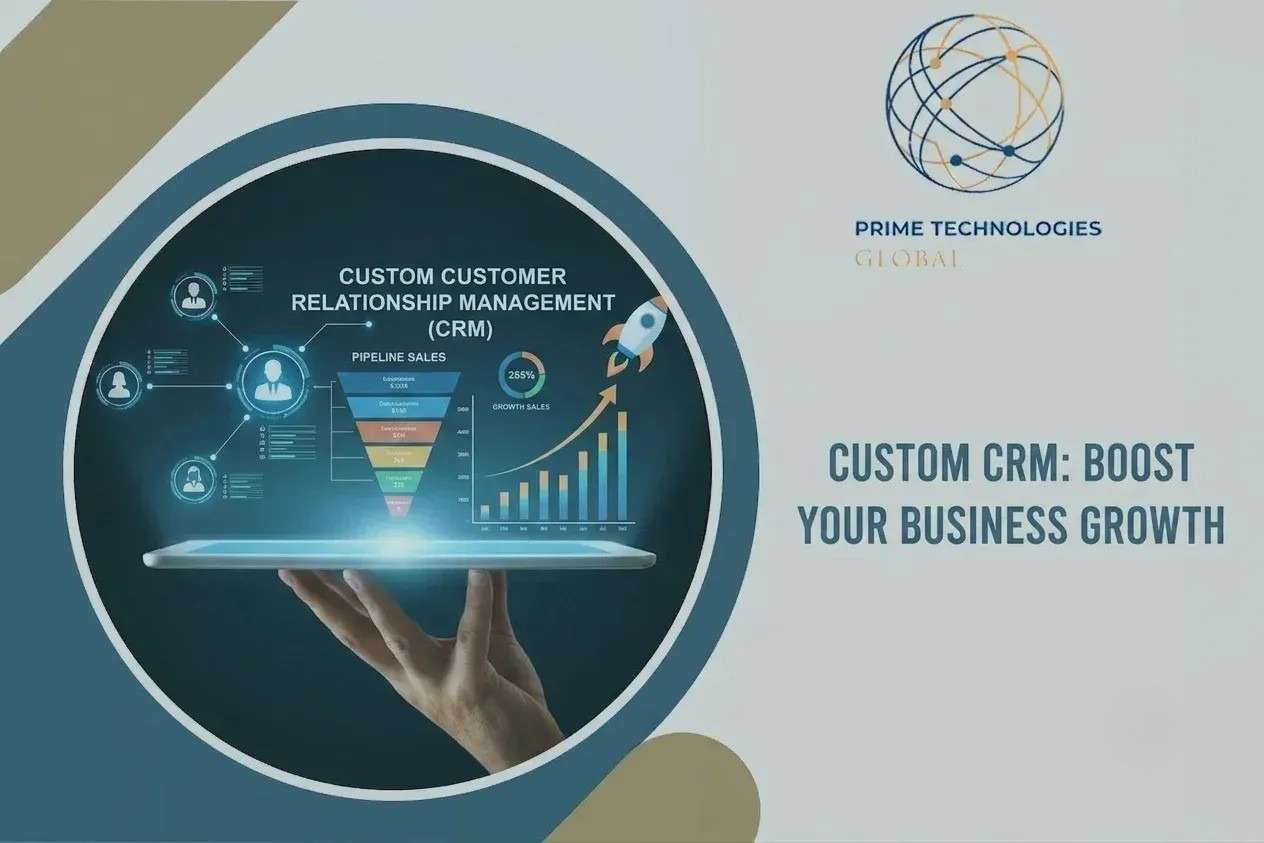
Ultimate Guide to Custom CRM: Boost Your Business Growth
You've felt it before. You log into your CRM (Customer Relationship Management software) to check on a lead, and instead of a quick answer, you get five clicks, three menus, and a dashboard full of fields your team never uses. That frustration is not a training problem. It is a fit problem.
Off-the-shelf platforms are built for the average business, and the average business does not exist. Every company sells differently, tracks different data, and runs different workflows. When your software does not match your process, your team builds workarounds in spreadsheets, sticky notes, and group chats. Deals slip through the cracks. Reporting turns into guesswork.

A Custom CRM fixes this by flipping the equation: instead of forcing your business into someone else's template, you build a system around your exact workflow, your exact sales process, and your exact reporting needs.
In this guide, we will walk through what a custom CRM actually is, the real ROI (return on investment) it delivers, the features worth prioritizing, and the step-by-step process for building one. By the end, you will know exactly what a tailored system can do for your sales pipeline, your team's productivity, and your bottom line.
What Is a Custom CRM?
A Custom CRM is customer relationship management software built specifically for your business, rather than a one-size-fits-all product sold to thousands of unrelated companies. It stores the same core information as any CRM system contacts, deals, communication history but every screen, field, and automation is designed around how your team actually sells and serves customers.
Generic platforms are built for the widest possible audience. That breadth is exactly what creates friction. Here's what typically goes wrong:
- Paying for features you never touch. Most CRM subscription tiers bundle dozens of modules together. Your team might use 20% of them, yet you pay for all of it every month.
- Expensive per-user licensing. As your team grows, so does your bill often steeply, since many providers charge per seat, per month.
- Rigid workflows that don't match your business. Generic CRM customization only goes so far. You can rename fields and rearrange a dashboard, but you usually cannot rebuild the underlying logic.
Consider a real estate agency. Agents need to track property listings, square footage, showing schedules, buyer preferences, and commission splits. A generic, retail-focused CRM has no concept of a "property record" at all. The agency ends up bolting on a separate tool just to manage listings, creating two disconnected systems instead of one unified view of the customer.
This mismatch is common. Industry research consistently shows that CRM adoption struggles inside organizations not because teams dislike the idea of CRM software, but because the interface feels bloated and disconnected from daily tasks. Analysts who study CRM software development note that poor user adoption driven by complexity and irrelevant features remains one of the top reasons CRM projects underdeliver on their promised ROI. A tailored system removes that friction because every screen exists for a reason your team already understands.
Top Benefits of Building a Custom CRM for Your Business
A custom CRM platform is an investment, so it needs to earn its keep. Here is where that value actually shows up.
100% Alignment With Your Workflow
Instead of adapting your sales process to fit the software, the software adapts to you. Your sales pipeline, your terminology, your approval steps all of it gets built into the system from day one. This is the core promise of true CRM customization: the platform reflects your business, not a generic template.
Seamless CRM Integration
A custom CRM connects directly with the tools you already rely on email marketing platforms, WhatsApp Business, accounting software, and more. Rather than manually exporting and importing data between disconnected apps, information flows automatically. This kind of workflow automation eliminates duplicate data entry and keeps every team member looking at the same up-to-date customer record.
Stronger Data Security
Customer data management is not just a nice-to-have; it is a liability if handled poorly. With a custom-built, often cloud-based CRM, you control exactly where sensitive customer information lives, who can access it, and how it is encrypted instead of depending entirely on a third-party vendor's shared infrastructure and its vulnerabilities.
Built-In Scalability
A custom CRM system grows alongside your business. Need a new module for a second product line? Want to add lead management system features for a new sales channel? Because you own the architecture, you extend it on your own timeline instead of waiting on a vendor's product roadmap.
The Productivity Payoff
Businesses that invest in tailored sales automation and process-specific tooling consistently report meaningful gains in team productivity. When reps spend less time hunting for information and more time selling because pipeline management, contact management software, and reporting live in one connected place the entire sales cycle moves faster.

Essential Features to Include in Your Custom CRM Design
Not every feature belongs in every build. But these four categories form the backbone of nearly every effective custom CRM software project.
Contact Management
A centralized hub for every phone number, email address, and interaction history. When a customer calls, your team should see the full relationship at a glance past purchases, open tickets, and every prior conversation without digging through separate systems.
Sales Pipeline Automation
Visual tracking boards, similar to Kanban boards, show exactly where each lead stands: new, contacted, proposal sent, closed. This kind of pipeline management turns a vague sales process into a clear, trackable system everyone can see.
Real-Time Analytics and Reporting
Clean dashboards that surface monthly revenue, team performance, and conversion rates the moment data changes. No more waiting for a weekly spreadsheet export to know how the month is trending.
Role-Based Access Control
Salespeople see only their own leads; managers see the full pipeline across the team. This protects sensitive customer lifecycle management data while still giving leadership the complete picture they need to make decisions.
Depending on your industry, you might also prioritize automated follow-up sequences, custom quote generation, or integrations with field service tools. The right feature list always starts with your actual bottlenecks, not a generic checklist.

Step-by-Step Process: How to Develop Your Custom CRM
Building custom CRM solutions sounds like a massive undertaking, but broken into stages, it is a manageable and predictable process.
Step 1 Goal Setting
Before any code is written, identify the exact problems the software needs to solve. Are leads falling through the cracks? Is reporting too slow? Is your team duplicating work across three different tools? Clear goals shape every decision that follows.
Step 2 UI/UX Wireframing
This is the blueprint and visual layout of the screens your team will use every day. Designers map out clean, simple layouts before any development begins, so the final product feels intuitive rather than bolted-together.
Step 3 Development and Testing
Engineers build the system in stages, and a small pilot group from your team tests each stage to catch bugs and workflow gaps early long before the full rollout.
Step 4 Implementation and Training
The system launches with a structured onboarding plan, so your staff adopts it smoothly instead of resisting "yet another new tool." Good training at this stage is often the difference between high adoption and a platform that quietly goes unused.
This structured approach to CRM system development keeps timelines realistic and ensures the final platform actually reflects how your team works, not just how a generic template assumes you work.
Ready to Scale Your Business?
Investing in a custom CRM is not just about getting new software. It is about future-proofing your business, eliminating daily clutter, and giving your team the exact tools they need to succeed. As your business grows, your enterprise CRM software should grow with it not force you into another expensive, disruptive migration a few years down the road.
Building a custom platform requires the right technical expertise. If you want a powerful, easy-to-use system built specifically around your unique business goals, Prime Technologies Global is here to help. Our team specializes in creating high-performance, custom software and digital marketing solutions that drive real results. Get in touch with Prime Technologies Global today to turn your vision into reality!
FAQ’s
What is a custom CRM system?
A custom CRM system is customer relationship management software designed and built specifically for one business, rather than sold as a generic product to many companies. It includes only the features, fields, and workflows that business actually needs, and it can integrate directly with existing tools like accounting software or messaging platforms.
Can I create my own CRM?
Yes. Businesses build custom CRM platforms by partnering with a software development team that handles the design, coding, and testing. The process typically starts with defining your specific goals and workflow, then moves through UI/UX design, development, testing, and staff training. Some technically skilled teams build simple internal versions themselves, but most businesses work with CRM development services to ensure the platform is secure, scalable, and properly integrated with other tools.
What are the 4 types of CRM?
CRM software is generally grouped into four types:
- Operational CRM: Streamlines day-to-day tasks like contact management, sales automation, and customer service workflows.
- Analytical CRM: Focuses on analyzing customer data to uncover trends, forecast sales, and guide business decisions.
- Collaborative CRM: Shares customer information across departments of sales, marketing, and support so everyone works from the same data.
- Strategic CRM: Centers on long-term customer relationship building and lifecycle management to improve loyalty and retention.
A well-designed custom CRM often blends elements of all four, tailored to the specific priorities of your business.
How much does a custom CRM cost?
Costs vary widely based on complexity, the number of integrations, and the size of your team. A simple custom CRM with core contact management and pipeline tracking will cost less than an enterprise CRM software platform with advanced analytics, multiple third-party integrations, and role-based access across large departments. Because pricing depends so heavily on scope, the most accurate way to get a number is to share your specific goals with a development partner and request a detailed quote based on your actual requirements.