
B2B Ecommerce | 2026 Guide to Strategy, and Trends
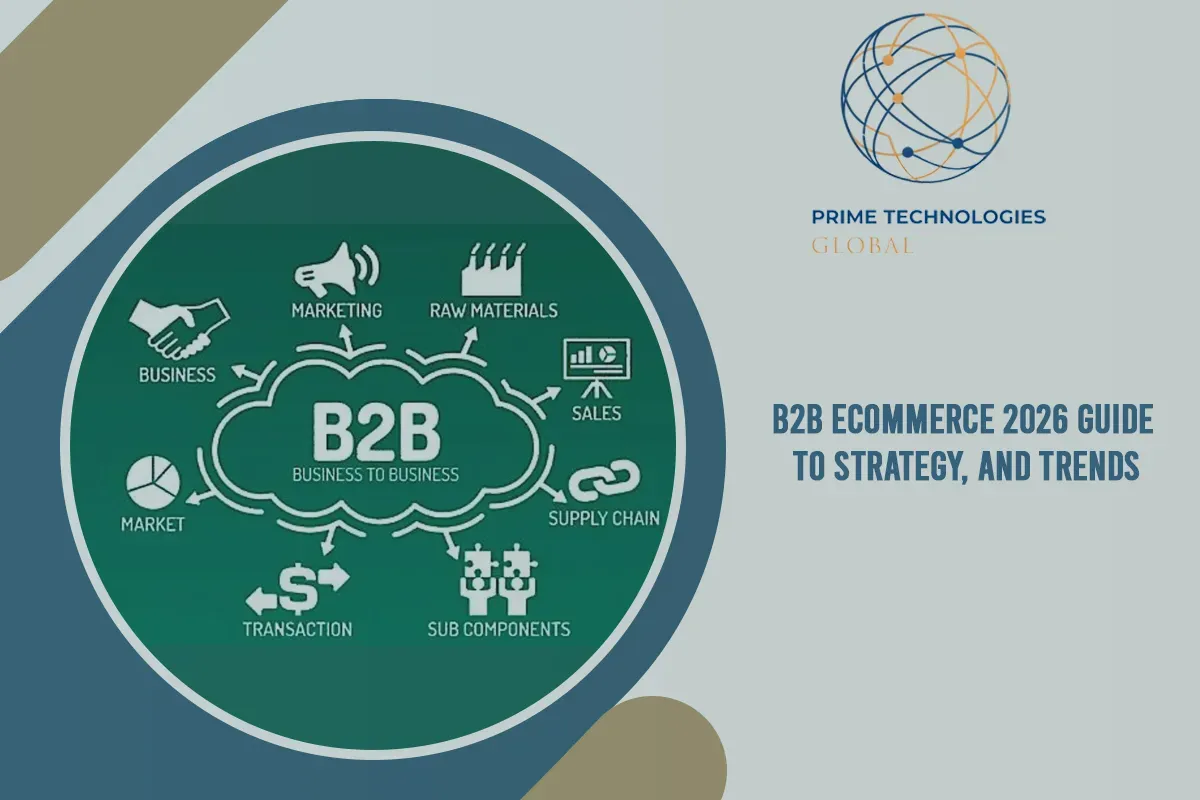
B2B ecommerce is the online buying and selling of products, services, or software between businesses, through self-service portals, marketplaces, mobile apps, and procurement systems instead of phone calls, emailed quotes, and sales-rep order entry. Also known as business to business commerce, it covers everything from a distributor's reorder portal to a manufacturer's direct-to-buyer store.
Quick answer: B2B ecommerce means companies sell to other companies online, with account-specific pricing, bulk ordering, approval workflows, and flexible payment terms (net 30/60, purchase orders) built into the buying experience. A working B2B ecommerce platform connects to your ERP, so stock, pricing, and invoices stay accurate in real time.
This guide shows you how to build one that works. You will learn what B2B ecommerce means and how its business models differ, how the history of B2B ecommerce explains today's buyer expectations, which B2B ecommerce features drive conversion, how to approach B2B ecommerce integration with your ERP, which B2B ecommerce trends matter in 2026, and a step-by-step B2B ecommerce strategy you can put into action.
Understanding B2B Ecommerce: Meaning, Core Models & Market Scale
The B2B ecommerce definition is simple: a transaction in which a business sells goods or services to another business through a digital channel. The buyer is an organization, not an individual, so the purchase involves budgets, approvals, contracts, and repeat ordering.
That difference shapes everything about the B2B ecommerce business. A consumer buys one item with a credit card. A procurement manager orders 400 SKUs against a negotiated price list, routes the order through a finance approver, and pays on net-60 terms.
B2B vs. B2C vs. B2B2C: How the Models Differ
Business to business commerce shares its storefront DNA with consumer retail, but the buying mechanics are very different. The table below shows where the two diverge, and where hybrid B2B2C models sit between them.
|
Dimension |
B2B Ecommerce |
B2C Ecommerce |
B2B2C |
|
Buyer |
Company, often several decision-makers |
Individual consumer |
Business partner and end consumer |
|
Pricing |
Contract, tiered, or volume-based |
Public list price |
Wholesale to partner, retail to consumer |
|
Order size |
Large, repeat, often bulk |
Small, one-off |
Mixed |
|
Payment |
PO, net terms, credit limits, invoice |
Card, wallet |
Both, depending on the leg |
|
Sales cycle |
Days to months, multiple approvers |
Minutes to days |
Varies |
|
Account setup |
Multi-user, role-based, approval rules |
Single login |
Partner portal plus consumer storefront |

Primary B2B Ecommerce Business Models
Most B2B E-commerce examples fall into one of three models. Many mature companies run more than one at once.
- Wholesalers and distributors: Sell a broad catalog from many suppliers to retailers, contractors, or resellers, usually through a login-gated portal with contract pricing.
- Manufacturers (direct-to-buyer): Sell directly to business customers or dealers, cutting out intermediaries to protect margin and own the customer relationship.
- B2B marketplaces: Multi-vendor platforms such as Amazon Business or vertical industrial marketplaces, where many sellers reach many corporate buyers through one storefront.
Hybrid note: A manufacturer that sells to distributors through a partner portal and to end customers through a public store is running a B2B2C model. This is increasingly common, and it makes channel-conflict rules and pricing governance part of your B2B ecommerce strategy from day one.
The History of B2B Ecommerce: From EDI to AI-Assisted Buying
The history of B2B ecommerce helps explain why buyers expect what they do now. Each wave removed one manual step from procurement, and each left a legacy system that modern platforms still have to connect to.
|
Period |
Milestone |
Why it mattered |
|
1960s–1970s |
Electronic Data Interchange (EDI) emerges |
Large firms exchanged purchase orders and invoices electronically, and EDI still runs inside many supply chains |
|
1990s |
Commercial web and early online catalogs |
Suppliers moved catalogs online, and the first B2B exchanges appeared |
|
Late 1990s–2000s |
E-procurement and punchout (Ariba, Commerce One) |
Buyers shopped supplier catalogs from inside their own procurement systems |
|
2000s |
Global B2B marketplaces such as Alibaba |
Small and mid-size firms reached international buyers online |
|
2015 |
Amazon Business launches |
Consumer-grade search, delivery, and reviews arrived in business buying |
|
2020–2021 |
Pandemic-driven shift to digital selling |
Field sales stalled, and many suppliers launched portals for the first time |
|
2023–2026 |
Composable commerce and generative AI |
Headless architectures and AI-assisted catalog and buyer tools became mainstream |

Market Scale: Why B2B Ecommerce Now Outsizes B2C
The numbers explain the urgency. Industry projections put global B2B ecommerce sales at roughly $36 trillion by 2026, many times the size of consumer ecommerce. Gartner's long-running forecast that most B2B seller-buyer interactions would happen in digital channels has largely proven out.
Verify before publishing: The $36 trillion figure comes from industry projections and varies by research firm and by how B2B marketplaces and EDI volume are counted. Confirm the current figure and cite the original report (for example UNCTAD, Statista, or Grand View Research) in the final version.
Key B2B Ecommerce Features of a High-Converting Platform
The features of B2B ecommerce that matter most are the ones that reflect how companies actually buy: hierarchies, negotiated terms, large repeat orders, and integration with procurement software. A consumer storefront with a login bolted on does not cover these needs.
Use the table below as a checklist when you evaluate any B2B ecommerce platform or build requirements for a B2B ecommerce solution.
|
Feature |
Business value and impact |
|
Custom contract pricing |
Displays tier-based, volume, or negotiated account pricing automatically at login, removing manual quoting |
|
Account and user roles |
Supports multi-user corporate accounts, custom approval workflows, and purchasing limits per role |
|
Bulk ordering and quick reorder |
Lets buyers upload SKUs by CSV, use quick-order matrices, and schedule recurring orders |
|
Punchout catalog integration |
Connects directly into enterprise e-procurement systems such as SAP Ariba and Coupa |
|
Flexible B2B payments |
Supports purchase orders, net terms (Net 30/60), credit limits, and embedded B2B buy-now-pay-later |
|
Real-time inventory and order status |
Shows live stock and shipment tracking, which cuts "where is my order" calls to your team |
|
Quote management (RFQ) |
Moves custom or large requests into a trackable quote-to-order flow |
|
Rich product information |
Delivers specs, documents, and cross-sell data that buyers use to evaluate without a rep |

Features That Drive the Most Revenue
Not every feature carries equal weight. Three tend to produce the fastest return, so build them first.
- Contract pricing at login. Buyers who see their own price immediately are far less likely to leave to request a quote.
- Quick reorder and saved lists. Repeat orders make up much of B2B revenue, so cutting a reorder from 15 minutes to 2 compounds across thousands of orders.
- Approval workflows and role-based access. Large accounts will not adopt a portal that cannot mirror their internal spending rules.
Common mistake: Many teams launch with a polished catalog and weak account management. Buyers then rebuild their approval process in email, and the portal becomes a read-only price list. Start with the account and role model, then layer on design.
Benefits of B2B Ecommerce for Suppliers and Buyers
The benefits of B2B ecommerce show up on both sides of the transaction.
- Lower cost to serve: Self-service orders need far less rep time and far fewer manual keying errors.
- Larger and more frequent orders: Easy reorder and cross-sell prompts raise average order value and order frequency.
- Faster cash conversion: Clean digital orders and invoices shorten the order-to-cash cycle.
- Wider reach: A portal and marketplace presence open regions and segments your field team cannot cover.
- Better data: Every search, cart, and reorder gives you buyer behavior that phone orders never captured.
- Buyer satisfaction: Buyers get 24/7 access, accurate pricing, and order transparency.
B2B Ecommerce Trends 2026: AI, Marketplaces, and Agentic Commerce
The B2B ecommerce trends below are the ones changing budgets and roadmaps this year. Each one affects how you build, market, and staff your digital channel.
1. Generative and Operational AI
AI now works on both sides of the catalog. On the supplier side, it speeds up product data management by drafting descriptions, normalizing attributes, and flagging gaps across thousands of SKUs. On the buyer side, it powers search that understands part numbers and plain-language requests, and it drives personalized catalog recommendations based on an account's purchase history.
Buyers are also using generative AI for supplier research. If your product data is thin, an AI-driven research tool has little to summarize, and your products get left out of the shortlist.
2. Agentic Commerce
Agentic commerce describes AI agents that carry out purchasing tasks on a buyer's behalf, such as monitoring stock, reordering consumables, or comparing quotes against policy rules. For suppliers, this raises the bar on clean, machine-readable product data, accurate pricing APIs, and predictable order endpoints.
Action point: Treat your catalog data and pricing API as products in their own right. Systems that cannot be read by an agent will be bypassed by buyers who use one.
3. B2B Online Marketplaces
Vertical, multi-vendor marketplaces, along with Amazon Business and specialized industrial platforms, give suppliers reach that a standalone portal cannot match. Many companies now run both: a marketplace for discovery and a branded portal for contract customers and high-margin repeat orders.
The trade-off is control. Marketplace fees and shared customer data need to be weighed against the new accounts they bring in.
4. Mobile-First Procurement
Field technicians, site managers, and procurement staff increasingly order from their phones, often at the point of need. That means dedicated mobile apps, responsive portals with barcode and part-number scanning, and messaging-based ordering such as WhatsApp integrations in regions where it is a default business channel.
5. Digital Transformation Becomes Operational, Not Experimental
The broader digital transformation story has matured. Companies no longer ask whether to sell online. They ask how to consolidate fragmented portals, retire legacy EDI-only flows where practical, and give sales teams one view of every account across channels.
Trend Impact at a Glance
|
Trend |
Primary impact |
First step to take |
|
Generative AI |
Faster data enrichment, better search and recommendations |
Audit and clean product data |
|
Agentic commerce |
Automated, rule-based reordering by buyers |
Expose reliable pricing and inventory APIs |
|
B2B marketplaces |
New-account reach and discovery |
Pilot one vertical marketplace |
|
Mobile-first buying |
Faster point-of-need orders |
Test mobile checkout and quick reorder |
|
Composable platforms |
Faster experience changes |
Map which components need independence |
Verify before publishing: Adoption statistics for generative AI in procurement research change quickly. Add a current, named survey figure (for example from Gartner, McKinsey, or Forrester) before this goes live.
Building an Actionable B2B Ecommerce Strategy: A 5-Step Growth Framework
A strong B2B ecommerce strategy starts with how your buyers purchase, not with a platform demo. The five steps below give you a sequence you can assign, schedule, and measure.
Step 1: Define Buyer Personas and Account Requirements
Map the roles inside your target accounts: the end user who needs the product, the buyer who places the order, the approver who controls spend, and the finance contact who pays. Each role needs something different from the portal.
Document pricing rules, payment terms, approval limits, and ordering patterns for your top 20 accounts. Those requirements become the first draft of your feature list.
Step 2: Audit Data and Infrastructure
Clean your product information management (PIM) data before you replatform. Missing attributes, inconsistent units, and duplicate SKUs will follow you onto any new platform and weaken search, filters, and SEO.
At the same time, inventory every system the portal must connect to: ERP, CRM, warehouse, tax, payment, and punchout. This inventory scopes the B2B ecommerce integration effort and exposes hidden dependencies early.
Step 3: Select the Right Platform
Choose a B2B ecommerce platform against your requirements list, not against a feature brochure. Common enterprise options include Adobe Commerce, Shopify Plus B2B, BigCommerce B2B Edition, and SAP Commerce Cloud, and the right pick depends on catalog complexity, pricing logic, ERP fit, and team capacity.
Score each vendor on the same criteria:
|
Evaluation criterion |
What to check |
|
Pricing and catalog logic |
Support for customer-specific price lists, tiered pricing, and large catalogs |
|
Account management |
Multi-user accounts, roles, approvals, and spending limits |
|
Integration |
Prebuilt ERP connectors, open APIs, and punchout support |
|
Payments |
PO, net terms, credit limits, and invoice payment |
|
Scalability and performance |
Catalog size, traffic peaks, and global rollout support |
|
Total cost of ownership |
License, implementation, integration, and ongoing support |
Step 4: Align Internal Sales Teams
Portal adoption fails when reps see it as a threat. Shift reps from transactional order-takers to strategic account advisors, and tie their incentives to account growth rather than order entry.
Show reps how the portal lets them see a customer's reorder behavior, spot lapsed accounts, and spend time on high-value conversations. Give them a way to place orders on a customer's behalf, so the portal remains the single source of order data.
Step 5: Optimize Search and Marketing
B2B ecommerce marketing pulls buyers into the portal and keeps them ordering. Focus on three areas:
- Technical SEO: Clean category structure, crawlable product pages, structured data, and fast load times so buyers find you during research.
- Dynamic content: Personalized catalogs, recommendations, and reorder prompts based on account history.
- Account-based marketing (ABM): Targeted campaigns for named accounts, aligned with sales outreach and portal onboarding.
Measure what matters: Track portal adoption rate (share of orders placed online), reorder rate, average order value, cost to serve, and time from order to cash. These metrics show whether the channel is replacing manual work or just adding another channel to manage.

B2B E-Commerce Examples: What the Leaders Do Differently
Looking at established players makes the model concrete. These B2B e commerce examples each show a different approach to the same buyer expectations.
|
Example |
Model |
What it demonstrates |
|
Amazon Business |
Marketplace |
Consumer-grade search and delivery, plus business features such as multi-user accounts, approval workflows, and tax-exempt purchasing |
|
Grainger |
Distributor |
A large industrial catalog with contract pricing, account tools, and procurement-system integration |
|
Alibaba.com |
Global marketplace |
Cross-border discovery between manufacturers and business buyers |
|
SAP Ariba and Coupa |
Procurement networks |
The buy-side systems your punchout catalog must connect to |
|
Manufacturer dealer portals |
Direct-to-buyer |
Order entry, warranty, and parts lookup for dealers, with pricing tied to dealer tier |
The common thread is not technology. Each makes the buyer's most frequent task, finding the right item at the right price and reordering it take seconds.
Conclusion
Building a modern B2B ecommerce operation takes more than launching a web portal. It requires enterprise integration with your ERP and CRM, personalized self-service that mirrors how your customers actually buy, and an architecture that can change as fast as your buyers do. The companies that get this right capture the digital-first buyer, lower their cost to serve, and grow reorder revenue without adding headcount.
The path is clear. Start with your buyers and their account rules, clean your product data, choose a platform that fits your integration and pricing needs, bring your sales team along, and invest in search and account-based marketing to drive adoption. As digital procurement accelerates through 2026 and beyond, suppliers with frictionless digital experiences will take market share, while those tied to manual and legacy processes will lose accounts to faster competitors.
Accelerate Your B2B Ecommerce Growth with Prime Technologies Global
Ready to modernize your digital infrastructure and build a scalable, enterprise-grade B2B ecommerce experience?
Prime Technologies Global delivers digital solutions built for complex business models. From custom B2B platform development and ERP integration to API-first composable commerce architectures, our engineering team helps you streamline operations, increase buyer engagement, and open new revenue channels.
Schedule a strategy consultation with Prime Technologies Global today and take your B2B digital sales engine to the next level.
Frequently Asked Questions
What is B2B ecommerce?
B2B ecommerce is the online sale of goods or services from one business to another. It differs from consumer retail through account-based pricing, bulk and repeat ordering, multi-user approval workflows, and payment methods such as purchase orders and net terms. Buyers typically use a portal, marketplace, or procurement system connected to the supplier's ERP.
What are the top 10 B2B ecommerce platforms?
The right choice depends on catalog size, integration needs, and team capacity, so treat this as a shortlist to evaluate, not a ranking. Widely used options include:
- Adobe Commerce (Magento)
- Shopify Plus (B2B)
- BigCommerce (B2B Edition)
- SAP Commerce Cloud
- Salesforce Commerce Cloud (B2B Commerce)
- commercetools (composable)
- OroCommerce
- Oracle Commerce
- Sana Commerce
- VTEX
Compare them on contract pricing, account management, ERP connectors, payments, and total cost of ownership using the evaluation table in Step 3 of the framework above.
Is B2B business still good in 2026?
Yes. B2B remains the larger side of commerce by transaction value, and buyer demand for digital channels keeps growing. Industry projections put global B2B ecommerce sales near $36 trillion in 2026. Strong demand does not mean easy growth, though: suppliers without self-service, accurate real-time pricing, and ERP integration are the ones losing ground.
What is B2B, B2C, C2B, and C2C in e-commerce?
These labels describe who sells to whom:
- B2B (business to business): A company sells to another company, such as a manufacturer selling parts to a distributor.
- B2C (business to consumer): A company sells to individual shoppers, such as a retailer's online store.
- C2B (consumer to business): An individual offers a product or service to a company, such as a freelancer selling work to a business or an influencer partnering with a brand.
- C2C (consumer to consumer): Individuals sell to each other, usually through a platform such as an online classifieds site or resale marketplace.