
Sales Funnel | Guide to Stages, Strategy, and Optimization
Most businesses aren't losing customers at the finish line; they're losing them somewhere in the middle, and nobody notices until the quarterly numbers come in short. A sales funnel gives you the map you need to see exactly where prospects drop off, why they leave, and what to fix first. This guide breaks down the sales funnel process stage by stage, with the strategies, benchmarks, and sales funnel metrics you need to turn cold traffic into paying, repeat customers.
What Is a Sales Funnel? Definition and Why It Matters
A sales funnel is a visual representation of the customer journey, mapping every step a prospect takes from their first interaction with your brand to the moment they become a paying customer and beyond. The sales funnel definition rests on a simple idea: not everyone who discovers your business is ready to buy today, so the funnel narrows on purpose, filtering broad awareness down into qualified, high-intent buyers.
Understanding the sales funnel meaning also means understanding the psychology behind it. Buyers move from cold, unaware skepticism to warm consideration and, eventually, confident decision-making. Each stage requires a different message, tone, and offering treating every prospect the same, regardless of where they sit in the funnel, is one of the fastest ways to lose them.
For B2B and B2C teams alike, a well-mapped sales funnel process delivers three concrete business benefits:
- Predictable revenue growth, because you can forecast based on stage-by-stage conversion rates rather than guesswork
- A more efficient sales process, since reps and marketers know exactly which content or outreach belongs at which stage
- Sharper, more targeted messaging that speaks to where a prospect actually is, not where you assume they are
|
📊 STAT SPOTLIGHT Salesforce research is widely cited as finding that a large majority of marketing leads commonly reported near 79% never convert into sales, largely due to a lack of structured nurturing. Without a defined funnel, that drop-off stays invisible until it shows up in your revenue. |
The Core Sales Funnel Stages (AIDA Model)
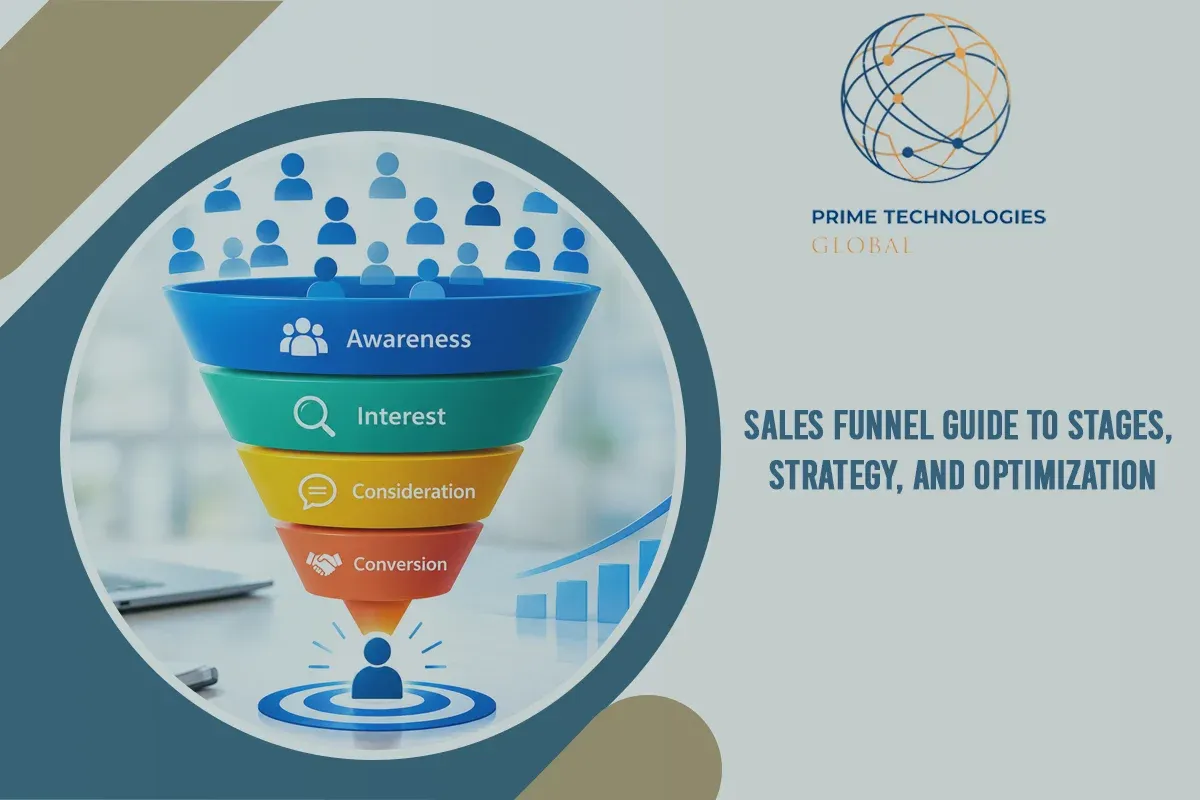
Most sales funnel stages trace back to the AIDA model Awareness, Interest, Desire, Action, a framework for persuasive marketing that remains the backbone of modern funnel design.
|
Stage |
Funnel Position |
Goal |
Primary Tactics |
|
Awareness |
Top (ToFu) |
Get noticed by the right audience |
SEO content, paid social, PR |
|
Interest |
Middle (MoFu) |
Educate and build trust |
Email nurture, lead magnets, webinars |
|
Desire |
Middle-Bottom |
Build product preference |
Case studies, demos, social proof |
|
Action |
Bottom (BoFu) |
Convert the prospect |
Landing pages, offers, checkout |

How Many Stages Does a Sales Funnel Have?
The classic model has four stages, but many marketers work with a 5-stage sales funnel instead, adding a post-purchase stage after Action usually labeled Retention or Advocacy to account for repeat business and referrals. Others split "Action" into "Conversion" and "Loyalty" to arrive at five. The stage count is a modeling choice, not a rule; what matters is that your funnel reflects your actual sales funnel process, end to end.
B2B and Enterprise Sales Funnels: What's Different
A b2b sales funnel and an enterprise sales funnel typically move slower and involve more stakeholders than a standard consumer purchase funnel. Where a consumer might complete the market funnel in a single session, enterprise buying committees often evaluate vendors over months, layering procurement, legal review, and budget approval on top of the standard funnel stages.
- Longer sales cycles, often spanning weeks to over a year for large enterprise deals
- Multiple decision-makers and influencers, not a single buyer
- Higher-touch nurturing: sales enablement content, ROI calculators, and personalized outreach
- Account-based marketing (ABM) frequently replaces broad top-of-funnel tactics
- An added procurement/contract stage between Desire and Action

Top-of-Funnel (ToFu) Strategies to Attract High-Quality Leads
Top-of-funnel work is where lead generation sales funnel efforts begin; the goal is reach and relevance, not an immediate sale.
- SEO and content marketing tailored to informational search intent the questions your future customers are already typing into Google
- Targeted PPC and paid social campaigns that put your offer in front of a defined audience before they search for you organically
- Irresistible lead magnets ebooks, whitepapers, checklists, and webinars that trade real value for contact information
Middle-of-Funnel (MoFu) Strategies to Nurture Prospects
Once a lead enters your system, building a sales funnel that actually converts depends on what happens next the nurture sequence.
- Email marketing automation and drip nurture sequences that deliver the right message at the right interval
- Retargeting campaigns aimed at recent site visitors who left without converting
- High-value comparison guides, product roundups, and solution webinars that move prospects from "interested" to "convinced"
|
📊 STAT SPOTLIGHT Campaign Monitor and similar industry benchmarks have put email marketing ROI in the range of $36 to $40 returned for every $1 spent among the highest of any digital channel. Verify the current figure against a live, citable source before publishing. |
Bottom-of-Funnel (BoFu) Strategies to Close the Sale
This is where hesitation gets addressed directly and friction gets removed.
- High-converting sales landing pages with a single, clear call to action
- Social proof testimonials, case studies, and video reviews placed exactly where doubt tends to appear
- Limited-time promotions, free trials, or money-back guarantees that lower the perceived risk of buying
Post-Purchase Funnel: Turning Buyers into Advocates
A sale is not the end of the funnel, it is the start of the highest-margin relationship a business has.
- Onboarding sequences that drive product adoption and early satisfaction
- Upselling, cross-selling, and subscription renewal models that grow account value over time
- Referral programs that turn satisfied customers into a low-cost acquisition channel
|
📊 STAT SPOTLIGHT Bain & Company research is widely cited as showing that increasing customer retention rates by just 5% can increase profits by 25% to 95%, depending on the industry, a reminder that the post-purchase funnel often delivers a better ROI than acquisition alone. Confirm the figure against the original Bain publication before publishing. |

How to Measure and Optimize Your Sales Funnel
Sales funnel management is not a one-time build it is an ongoing discipline of measurement and refinement. Sales funnel optimization starts with tracking the right sales funnel metrics at every stage.
Key Sales Funnel Metrics to Track
- Conversion rate per stage where, specifically, prospects are dropping off
- Customer Acquisition Cost (CAC) what it actually costs to win a customer
- Customer Lifetime Value (CLV) what that customer is worth over time
- Bounce rate and engagement early signals of a mismatched offer or message
From there, sales funnel analysis relies on a repeatable process: identify leaks using conversion rate optimization (CRO) tools, run structured A/B tests on headlines, email subject lines, landing page layouts, and CTAs, and use GA4's funnel exploration reporting to visualize exactly where the biggest opportunities sit.

|
💡 PRO TIP Pro tip: Treat funnel optimization as a monthly cadence, not a quarterly project. Small, continuous tests compound into significant conversion gains far more reliably than occasional large redesigns. |
Building a Sales Funnel That Actually Converts
A well-structured sales funnel turns scattered marketing effort into a predictable revenue engine. Mapping every stage of the buyer's journey, matching content and offers to intent, and continuously optimizing for friction points is what separates businesses that scale their conversions from those that simply generate traffic and hope. The fundamentals covered here from top-of-funnel awareness through post-purchase advocacy apply whether you are running a lean startup funnel or managing a complex, multi-stakeholder enterprise sales funnel, and they remain just as relevant now as buyer journeys grow more fragmented across channels and devices.
Ready to Turn More Traffic Into Revenue?
Building a high-converting sales funnel takes more than a landing page and a hope. At Prime Technologies Global, we design, build, and optimize full-funnel digital growth strategies SEO, paid media, and conversion-focused web design engineered to turn cold traffic into loyal, repeat customers. Contact Prime Technologies Global today to map your funnel, close your leaks, and start converting like the top 1% in your industry.
Frequently Asked Questions
What are the 5 stages of a sales funnel?
While the classic AIDA model outlines four stages Awareness, Interest, Desire, and Action many marketers use a 5-stage sales funnel that adds a post-purchase stage. A common 5-stage breakdown is: Awareness, Interest, Desire, Action (the purchase itself), and Retention/Advocacy (turning buyers into repeat customers and referrers). Some frameworks instead split "Action" into "Conversion" and "Loyalty" to reach five stages; the exact labels vary by source, but the underlying sales funnel process is the same.
What is the 10-3-1 rule in sales?
The 10-3-1 rule is a sales prospecting benchmark suggesting that, on average, a salesperson needs roughly 10 qualified leads to generate 3 solid opportunities, which in turn produce 1 closed deal. It is used as a rough planning ratio for setting outreach and pipeline-generation targets rather than a fixed law, and actual ratios vary significantly by industry, deal size, and funnel maturity.
What is funnel optimization and what does it do?
Sales funnel optimization is the ongoing process of analyzing performance data at each stage of the funnel traffic, engagement, conversion rate, and drop-off points and making targeted changes to improve results. It typically involves A/B testing landing pages, refining lead-nurturing sequences, tightening CTAs, and using conversion rate optimization (CRO) tools to find and fix the specific points where prospects disengage, with the goal of moving more qualified leads through to purchase without increasing spend.
Is a sales funnel still relevant today?
Yes. While buyer journeys have become less linear, prospects now move between channels, devices, and touchpoints in almost any order. The underlying sales funnel concept remains a foundational tool for organizing marketing and sales efforts, forecasting revenue, and identifying where prospects are lost. Modern teams often pair the funnel with broader "flywheel" or lifecycle models, but nearly all of those models still rely on funnel-style stage analysis under the hood.