
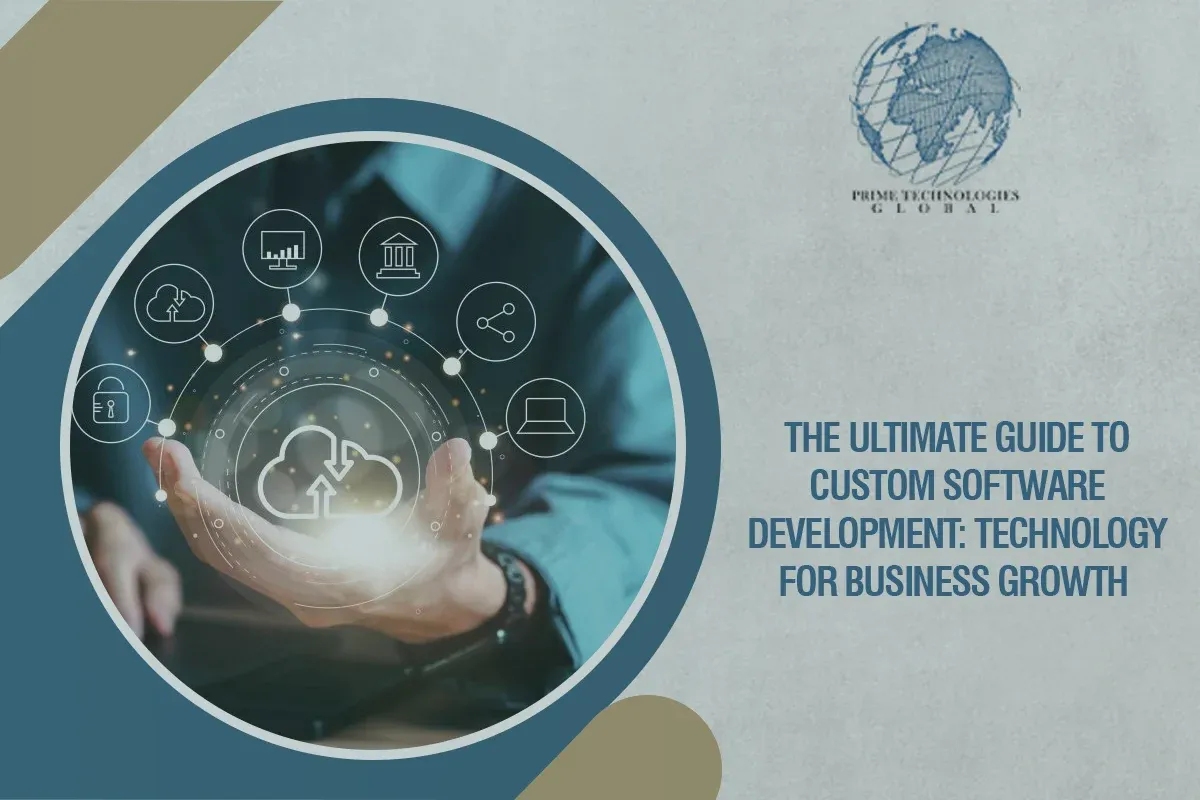
The Ultimate Guide to Custom Software Development: Technology for Business Growth
Introduction
Imagine buying a tailored suit versus one off the rack. The off-the-rack suit might fit okay, but the tailored one moves with you, reflects your personality, and gives you a competitive edge the moment you walk in the room. In the digital world, custom software development is that tailored suit.
While commercial off-the-shelf (COTS) software offers quick fixes, it forces businesses to reshape their processes around the software's limitations. Custom software does the opposite; it is engineered from scratch to align perfectly with your unique business goals, workflows, and scaling ambitions.
This guide covers everything decision-makers need to know: what custom software development really is, how it stacks up against off-the-shelf alternatives, the full development lifecycle, the trends reshaping the industry, and how to choose the right custom software development company for your needs.
What Is Custom Software Development?
Custom software development is the process of designing, building, deploying, and maintaining software applications that are purpose-built to meet the specific operational, functional, and strategic requirements of a particular business or organization, as opposed to using generic, pre-packaged solutions.
Also called bespoke software development, this approach produces proprietary applications that no competitor can replicate out of the box. Whether it is a custom healthcare software development platform built to meet HIPAA compliance standards, a FinTech-grade secure payment gateway, or a custom CRM built for a niche logistics firm, the defining characteristic is that every feature, workflow, and integration is designed for you.
Custom Software vs. Standard Commercial Software: The Core Difference
Take Microsoft Office as an example. It is a powerful suite, but it was built for everyone, which means it serves no single business exceptionally well. A custom software application development project, by contrast, produces a tool that your team can use on day one without training, because it mirrors the exact way your business operates.
Real-World Industry Examples
- Healthcare: Custom medical software development platforms with HIPAA-compliant patient portals, EHR integrations, and telehealth modules.
- FinTech: Bespoke payment gateways with custom fraud-detection algorithms and regulatory compliance baked in.
- Retail & E-Commerce: Proprietary inventory management and order fulfillment systems that sync across warehouses in real time.
- Logistics: Custom route optimization platforms that integrate directly with fleet tracking, driver apps, and client portals.
According to Grand View Research, the global custom software development market is on a strong growth trajectory, driven by accelerating digital transformation across every major industry sector. Enterprises are moving away from rigid SaaS platforms as they discover the long-term cost and agility advantages of owning their technology.

Custom Software vs. Off-the-Shelf Software: A Side-by-Side Comparison
Before committing to any technology investment, smart decision-makers weigh their options clearly. Here is an honest, comprehensive breakdown of both paths:
|
Factor |
Custom Software Development |
Off-the-Shelf Software |
|
Initial Cost |
Higher upfront investment |
Lower initial cost |
|
Time to Deploy |
Longer development timeline |
Immediate deployment |
|
Scalability |
Built to scale with your growth |
Limited by the vendor roadmap |
|
Customization |
100% tailored to your workflows |
Fixed, generic features |
|
Integration |
Native fit with existing systems |
May require workarounds |
|
Security |
Bespoke, less exposed to mass attacks |
Common attack vectors are known |
|
Licensing Fees |
None, you own the code |
Ongoing per-user subscription costs |
|
Competitive Edge |
Unique, proprietary advantage |
Same tool as your competitors |
|
Long-Term ROI |
High, no recurring fees, fully owned |
Costs compound over time |
The Bottom Line
Off-the-shelf software wins on speed and low initial cost. But as your business scales, those recurring per-user subscription fees compound rapidly. A 200-person team paying $50 per user per month is spending $120,000 annually on software they do not fully own and cannot customize, and that figure grows with every new hire.
Custom software development services flip that model. The upfront investment is higher, but you own the asset permanently, pay no licensing fees, and build a proprietary competitive advantage that no competitor can replicate by simply purchasing the same SaaS tool.
Key Benefits of Custom Software Development for Businesses
The ROI argument for custom software is compelling, but the advantages run much deeper than simple cost savings. Here are the strategic benefits that C-level executives and technology leaders consistently cite:
Targeted Efficiency & Elimination of Bloatware
Custom business software development gives your team exactly the tools they need and nothing they do not. Off-the-shelf platforms are packed with features designed for a broad audience, creating cluttered interfaces and forcing employees to navigate menus irrelevant to their roles. Custom software eliminates this friction, improving adoption rates and day-to-day productivity.
Enhanced Security Posture
Mass-market software platforms are high-value targets for cybercriminals precisely because their codebases and vulnerabilities are widely known. Custom software developers build applications with security architectures specific to your business, making automated hacking scripts far less effective. For sectors like healthcare and finance, this is not just an advantage; it is a compliance requirement.
Long-Term Cost Savings at Scale
The "per-user" licensing trap is one of the highest hidden costs in enterprise technology. Custom software has no recurring licensing fees. As your headcount grows, your software costs do not. For businesses scaling beyond 50-100 users, the break-even point against an equivalent SaaS subscription typically arrives within 2-4 years, after which the savings are substantial.
Seamless System Integration
Customized software development services are built to integrate natively with your existing legacy systems, third-party APIs, and data infrastructure. Off-the-shelf tools often require costly middleware, workarounds, or the abandonment of legacy systems entirely, creating data silos and operational inefficiencies.
Ownership and Intellectual Property
When you engage a reputable custom software development company, you retain 100% ownership of the source code. This is a valuable business asset, one that can be leveraged, sold, licensed, or evolved without dependency on any vendor's pricing decisions or product roadmap.
Genuine Competitive Differentiation
Your competitors can purchase the same CRM, the same project management platform, and the same analytics dashboard. They cannot replicate your proprietary custom-built system. For businesses where operational agility and process efficiency are core differentiators, this is a decisive strategic advantage.

The Custom Software Development Life Cycle (SDLC) Explained
What is the custom software development life cycle? The SDLC is a structured, phase-by-phase process that takes a software project from initial concept through to live deployment and long-term maintenance. For custom software, it typically consists of six core phases: Discovery & Requirements, Design & Architecture, Development, Testing & QA, Deployment, and Maintenance & Support.
Understanding this process helps businesses set realistic timelines, budget accurately, and collaborate effectively with their development partner. Here is what each phase involves:
|
Phase |
What Happens |
Key Deliverable |
|
1. Discovery & Requirements |
Stakeholder interviews, pain-point mapping, and scope definition |
Project Brief & BRD |
|
2. Design & Architecture |
Wireframes, UI/UX mockups, system architecture planning |
Prototypes & Tech Stack Spec |
|
3. Development & Coding |
Agile sprints, front-end & back-end engineering |
Working Software Increments |
|
4. Testing & QA |
Bug hunting, security audits, User Acceptance Testing (UAT) |
QA Report & Sign-off |
|
5. Deployment |
Production launch, CI/CD pipeline activation, go-live |
Live Software Environment |
|
6. Maintenance & Support |
Patches, updates, feature scaling, SLA-backed support |
Ongoing Support Agreement |
Requirements Gathering & Analysis
This is the most critical phase and the one most often underestimated. Experienced custom software development agencies invest significant time here, conducting stakeholder workshops, mapping business processes, and defining a precise project scope. A robust Business Requirements Document (BRD) produced at this stage prevents costly mid-project pivots.
Design & Architecture
With requirements locked, designers and architects create wireframes, UI/UX prototypes, and a detailed technical architecture document. This stage defines the technology stack, the programming languages, frameworks, cloud infrastructure, and database systems that will power the application.
Development & Coding
The engineering phase. Most reputable custom software development companies in the USA and globally operate using Agile methodologies, breaking development into short, iterative sprints (typically 2-week cycles) that allow for continuous feedback and adaptation. This reduces risk and keeps the project aligned with business needs as they evolve.
Testing & Quality Assurance
Rigorous QA testing is non-negotiable. This phase covers functional testing, performance and load testing, security audits, and User Acceptance Testing (UAT), where real end-users validate that the software meets their needs before launch. For custom healthcare software development and FinTech projects, regulatory compliance testing is also conducted here.
Deployment & Implementation
The software goes live. Modern custom software development teams use CI/CD (Continuous Integration/Continuous Deployment) pipelines to automate deployment, minimize downtime, and ensure a smooth transition to the production environment. Data migration and staff onboarding are managed during this phase.
Maintenance & Support
Software is a living product. The maintenance phase covers ongoing bug fixes, security patches, performance monitoring, and feature enhancements as your business evolves. Always clarify the SLA (Service Level Agreement) terms with your development partner before signing, specifically, response times, uptime guarantees, and what is included in post-launch support.

Essential Trends Shaping Custom Software Development in 2026 and Beyond
The custom software development landscape is evolving rapidly. Businesses that engage with these trends at the architecture stage build applications that are future-proof, not just functional for today.
AI and Machine Learning Integration
Artificial intelligence is no longer a premium add-on; it is increasingly a baseline expectation. Forward-looking custom software development solutions now embed machine learning models directly into business workflows: predictive analytics engines, intelligent document processing, recommendation systems, and automated anomaly detection. According to McKinsey research, organizations that embed AI into their proprietary software consistently report measurable improvements in operational efficiency and decision-making speed.
Cloud-Native Architecture
Building cloud-native applications from the ground up using platforms like AWS, Microsoft Azure, or Google Cloud gives businesses elastic scalability, geographic redundancy, and remote accessibility without the overhead of on-premise infrastructure. For custom software developers, this also means leveraging serverless computing and containerization (Docker, Kubernetes) to build more resilient, cost-efficient systems.
Low-Code/No-Code Hybrid Approaches
The rise of low-code/no-code tools has created a valuable hybrid model: professional developers use these platforms to accelerate prototyping and early-stage development, while writing fully custom code for the core logic and integrations that require precision. This approach reduces time-to-market without sacrificing quality or control.
Cybersecurity by Design
With data breaches costing organizations an average of millions of dollars, security is no longer retrofitted into software; it is architected from the start. Zero-trust frameworks, end-to-end encryption, and automated vulnerability scanning are standard practices in quality custom software application development today.
How to Choose the Right Custom Software Development Partner
Selecting the right custom software development company is one of the most consequential technology decisions your business will make. The wrong choice costs time, money, and market position. Here is how to evaluate candidates systematically:
Evaluate Technical Expertise and Portfolio Depth
Request case studies from the best custom software development companies you are considering, specifically examples that match your industry or technical complexity. A company that has built custom healthcare software development services or complex custom CRM development software solutions has demonstrated it can navigate the compliance, integration, and UX challenges specific to your domain.
Key technical indicators to assess:
- Stack proficiency: Do they demonstrate expertise in the languages and frameworks your project requires?
- Architecture decisions: Can they articulate why they would choose specific cloud platforms, databases, or frameworks for your use case?
- Security practices: How do they handle data security, code audits, and penetration testing?
Assess Communication and Cultural Fit
Technical capability is table stakes. The custom software development agency you choose must also be a reliable communication partner. For projects lasting 6-18+ months, misaligned communication styles cause more project failures than technical gaps.
- Non-negotiable communication standards:
- Regular sprint reviews and demo sessions (at least bi-weekly)
- A dedicated project manager as your single point of contact
- Clear escalation paths and documented decision logs
- Strong English proficiency if you are working with an offshore team
Confirm IP Ownership in Writing
This is non-negotiable: your contract must explicitly state that your business owns 100% of the source code upon final payment. Some vendors retain co-ownership or include clauses that restrict your ability to switch development partners in the future. Review this clause with a legal advisor before signing.
Red Flags to Watch For
- Vague or absent SLA terms in the contract
- No references or verifiable case studies in your industry
- Inability to explain their development methodology clearly
- Proposals that seem unusually low-quality custom development have a floor cost
- No clear IP ownership clause or resistance to including one
Conclusion
Investing in custom software is a strategic business decision that allows organizations to bypass the limitations of generic platforms and build proprietary tools tailored to their unique operational needs. By prioritizing purpose-built solutions, companies can secure long-term gains through enhanced operational efficiency, eliminated licensing fees, and improved security, ultimately outmaneuvering competitors who rely on off-the-shelf software.
The path to success begins with selecting a development partner that demonstrates deep industry expertise, transparent communication, and a commitment to 100% intellectual property ownership. While the upfront investment is higher, the enduring return on investment and the ability to own your software asset permanently provide a decisive competitive advantage for any growth-oriented enterprise.
Ready to Stop Paying for SaaS Bloat?
Stop renting your business tools and start owning them. At Prime Technologies Global, we help enterprises build secure, scalable, and proprietary software that grows with your business, not your licensing fees.
Frequently Asked Questions
How Much Does Custom Software Development Cost?
Costs typically range from $15,000 for simple MVPs to over $500,000 for enterprise-grade systems. The total price depends on project complexity, feature scope, team location, and timeline. Requesting a discovery engagement produces a scoped estimate, not a ballpark figure.
How Do You Choose the Right Custom Software Development Partner?
Evaluate candidates by their technical portfolio, communication practices like Agile methodology, and clear post-launch support policies. Verify that they provide 100% source code ownership in writing. Shortlist several agencies, conduct reference calls, and request a paid discovery phase before committing.
Is Your Business Ready to Develop Custom Software?
You are ready if your team relies on manual workarounds, you pay for unused SaaS features, or your licensing costs scale disproportionately as you grow. Additionally, businesses handling sensitive data or those requiring unique operational models often find that custom solutions are necessary.
How to Find Customers for Software Development?
The most effective channels include high-authority B2B content marketing, targeted LinkedIn outreach to technology leaders, and industry-specific networking. Case study-driven referrals from existing enterprise clients and active participation on platforms like Clutch or G2 are also essential for driving qualified, high-intent inbound traffic.
How to Sell Custom Software Development Services?
Focus on a consultative process that prioritizes deep discovery of the prospect's business pain points over simple transactional sales. Quantify their current inefficiencies, such as wasted labor hours or high licensing costs, then present custom software as a strategic investment with a clear ROI.